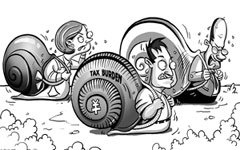
The debate on the tax burden is growing among Chinese as they become more conscious about being taxpayers. A recent Chinese Academy of Social Sciences report has added vigor to that debate by saying that "the per capita tax burden in China is nearly 10,000 yuan ($1,633)".
Perhaps taxpayers' misconception about "per capita tax burden" is to blame for the renewed debate. "Per capita tax burden" is the same as "average fiscal revenue". Academics and government officials are known to use the concept of "macro tax burden", which takes into account the ratio of total government revenue in a country's GDP. But the concept of "per capita tax burden" is relatively new to us.
|
 |
|
|
The "macro tax burden" index can be more meaningful while measuring a country's tax burden, because the ratio of fiscal revenue accounting for GDP can better reflect the concentration ratio of government financial resources in a specific economic structure, and manifest certain fiscal and taxation systems. It also can analyze the characteristics of an economy's financial allocation and the government's role in controlling its resources for administration.
If we compare this index with the international level, going by the International Monetary Fund's standards, China's current ratio is less than 35 percent, which is the average of developing countries but much lower than that of advanced economies. This means China's macro tax burden is not that high and there is little sense in introducing a "per capita tax" index by quantifying the macro tax burden to individuals. For one thing, it can easily cause misunderstandings among the public. In China, less than 10 percent of the government's total tax comes directly from individuals, with companies paying more than 90 percent. This is because the tax system is aimed at redistributing social wealth from better-off groups to the poorer ones.
A deeper analysis of the tax burden, however, will show that not all the amount companies pay as taxes comes from their own pockets. Except for the corporate income tax, companies pass on the other taxes such as value-added tax and business tax to parties down the supply/delivery chain or ultimately to consumers. Such a tax is called "indirect tax". In China, indirect tax makes up the main part of the tax system, and it is the key to understanding the tax burden issue.

Copyright 1995 - . All rights reserved. The content (including but not limited to text, photo, multimedia information, etc) published in this site belongs to China Daily Information Co (CDIC). Without written authorization from CDIC, such content shall not be republished or used in any form. Note: Browsers with 1024*768 or higher resolution are suggested for this site.
License for publishing multimedia online 0108263 Registration Number: 20100000002731