 |
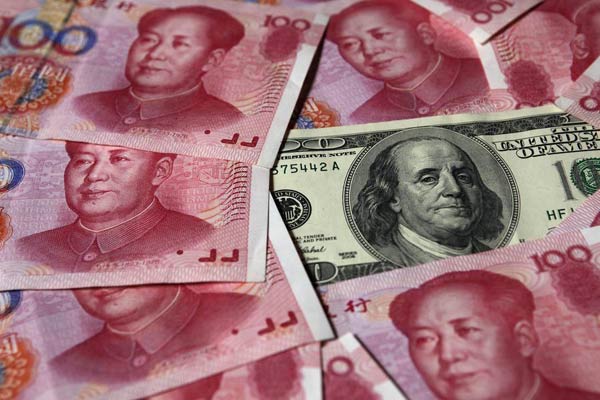
| A $100 banknote is placed next to 100 yuan banknotes in this Oct 16, 2010 file picture illustration taken in Beijing. [Photo/Agencies] |
Strategic vision
Gong Jie, a partner in the Hong Kong office of global private equity firm Pantheon, says: "There are more trades sales now as a result of drivers that include domestic buyers alongside well-financed foreign buyers, industry consolidation, and business owners' greater willingness to sell majority stakes in their firms as a way of managing succession."
Jenny Liu, a partner with international law firm Squire Patton Boggs, says trade sales have become a trend over the past five years. The reasons include less favorable valuations for Chinese firms on foreign stock exchanges and the much healthier balance that now exists between the two exit options in China's private equity market.
In recent years, the Chinese private equity market has become much more competitive because of the emergence of domestic funds and the growth of large Chinese firms that compete with private equity firms to make acquisitions of highgrowth targets, Liu says.
Cash-rich Internet firms such as Baidu, Alibaba and Tencent have made many acquisitions of smaller firms, she says, and these firms believe that great strategic synergy can be achieved.
Such competition has made funds more focused on selecting opportunities in certain industries, and more professional in devising investment strategies, Liu says.
Benjamin Kroymann, anothhave bought to overseas stock exchanges. This follows the er partner with Squire Patton Boggs, says it is now much less common for foreign firms to take Chinese firms they wave of delisting of Chinese firms on US stock exchanges in recent years.
Longtop, a Chinese software company, delisted from Nasdaq in August 2011 after its auditor, Deloitte, accused it of "very serious defects" in its accounting. Longtop was among the 29 Chinese companies delisted from US bourses in a short span of time in 2011, with a combined paper loss of $5.7 billion.
Another 48 companies had trading in their shares suspended, or received suspension warnings from the US Securities and Exchange Commission.
"Overseas IPOs have become more difficult as an exit option for Chinese companies because we've had issues, and skepticism from investors has kept valuation for Chinese companies on overseas stock Exchanges low," Kroymann
Guy Hands, chairman and chief investment officer of Terra Firma, a private equity firm founded as a spin-off of Nomura Bank in 2002, says trade exit is favored more by foreign private equity firms than domestic ones.
Firm target
"Chinese firms still target pre-IPO opportunities, looking for fundamentally strong companies that desperately need capital injection," Hands says.
Comparatively, he says, European private equity firms need to have the expertise of patiently guiding portfolio companies to achieve operational excellence, thereby creating value rather than simply finding it.
"Helped by the IPO slowdown and industry consolidation waves, the Chinese market is experiencing a remarkable boom in merger and acquisition activities," Hands says. "There are now more regulatory requirements on listing procedure reforms, which may fundamentally change the private equity industry in China in the short term."
Even though Terra Firma has no investment in China, it has an office in Beijing and is looking for opportunities to invest in the Chinese market when the time is ripe, he says.
David Rubenstein, cofounder and co-CEO of global asset management firm The Carlyle Group, says trade sales are the preferred options for his team, because strategic buyers usually pay the highest prices.
"In Asia and China, our exits have been probably selling more to strategic buyers and financial buyers," Rubenstein says. "IPO is not a big deal to us. People get excited with IPOs. Sometimes stocks go up. But stocks can't always go up. Sometimes they go down, too."
Zhu of Bain Capital Asia says China's private equity market is set to grow much further, because the penetration rate is still low compared with what prevails in developed economies. The total private equity investment as a percentage of GDP is about 2 percent in the United States, 1 percent in Europe, but only less than 0.5 percent in China, he adds.
Zhu's optimism is shared by Pantheon's Gong, who says that private equity firms are well positioned to drive increased professionalism within Chinese businesses. "There is also a shake-up in the local private equity landscape, which has seen competition reduce and valuations become more attractive," Gong says.

Copyright 1995 - . All rights reserved. The content (including but not limited to text, photo, multimedia information, etc) published in this site belongs to China Daily Information Co (CDIC). Without written authorization from CDIC, such content shall not be republished or used in any form. Note: Browsers with 1024*768 or higher resolution are suggested for this site.
License for publishing multimedia online 0108263 Registration Number: 130349