 |
|
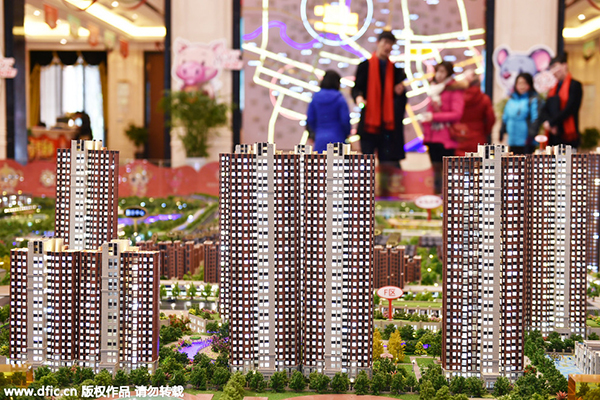
Homebuyers look at models of residential apartment buildings at a sales office in Luoyang, Henan province, Jan 24, 2016. [Photo/IC] |
Of the 70 large and medium-sized cities surveyed in February, new home prices climbed month on month in 47, up from 38 the previous month, the National Bureau of Statistics (NBS) said Friday.
Meanwhile, 15 reported month-on-month price declines, down from 24 in January, according to NBS data.
On a yearly basis, 32 cities posted new-home price increases and 37 reported falls, compared with 25 and 45 in January.
New-home prices soared 57.8 percent year on year in the southern city of Shenzhen, the sharpest increase last month among all major cities, followed by Shanghai and Beijing, where prices surged 25.1 percent and 14.2 percent year on year. Northeastern city of Dandong registered the steepest price decline, dropping by 3.9 percent.
Prices for existing homes also warmed up last month, with 34 cities reporting higher month-on-month prices and 28 reporting lower prices.
China's property market started to recover in the second half of 2015 after cooling for more than a year, boosted by government support measures, including interest rate cuts and lower deposit requirements.
Last month, taxes on some property transactions were slashed and further reductions to the minimum downpayments for first- and second-time home buyers were announced.
Related story
Property market collapse ruled out?by Hu Yuanyuan, China Daily
China's real estate market will not collapse as happened in Japan two decades ago, because the situations of the two countries are very different, Minister of Housing and Urban-Rural Development Chen Zhenggao said on Tuesday.
"It is not appropriate to compare the real estate market in China with that of Japan in the 1990s, as the two countries are in different stages of economic development and urbanization. We also have different macro policies to control the situation," Chen said at a news conference.
Chen's remarks came amid growing concern over the potential risks in China's real estate sector as home prices in Beijing, Shanghai and Shenzhen have surged by 20 to 30 percent since the Lunar New Year. In Shenzhen, prices have increased by 72 percent over the past 12 months, according to the Shenzhen Urban Planning, Land and Resources Commission.
The supply-demand imbalance and the easing of monetary policy are regarded as major reasons for the latest price surges in big cities.
The soaring prices have led to worries that China may repeat what happened in the 1990s in Japan, where the burst of the real estate bubble resulted in an economic recession for almost 20 years.
"Stabilizing home prices in first-tier cities and some second-tier cities is one of our primary tasks. We will take timely, relevant measures, including increasing the supply of land and small and medium-sized apartments, using different policies and cracking down on illegal behavior to push up prices," said Chen.
According to Li Daokui, a political adviser and an economics professor at Tsinghua University, there is no bubble in the first-tier cities' property market, based on the price-to-rent ratio. More supply is needed to ease price increases in such cities, Li said.
Yan Yuejin, director of the Shanghai E-House Real Estate Research Center, said the market frenzy in first-tier cities' real estate sector, though a bit unexpected, was fundamentally triggered by the imbalance of supply and demand.
"The international experience sometimes is not applicable to China. For instance, China has more than 3,000 cities, which Japan doesn't have. The situation in China's real estate sector is much more complicated than that in Japan," said Yan.
Home prices probably will increase further in the long run, Yan said.
Chen said he was very confident in the future development of China's real estate sector, due to the country's solid economic growth and the potential for urbanization.
China's GDP is expected to grow by 6.5 to 7 percent this year, still much faster than the growth of most economies across the world. The urbanization rate, now at 56.1 percent, will reach 60 percent by the end of the 13th Five-Year Plan (2016-20), indicating strong market demand for housing in the years ahead, he added.
Du Juan contributed to this story.

Copyright 1995 - . All rights reserved. The content (including but not limited to text, photo, multimedia information, etc) published in this site belongs to China Daily Information Co (CDIC). Without written authorization from CDIC, such content shall not be republished or used in any form. Note: Browsers with 1024*768 or higher resolution are suggested for this site.
License for publishing multimedia online 0108263 Registration Number: 130349