Comments
  Print
Print  Mail
Mail  Large Medium Small
|
 |
|
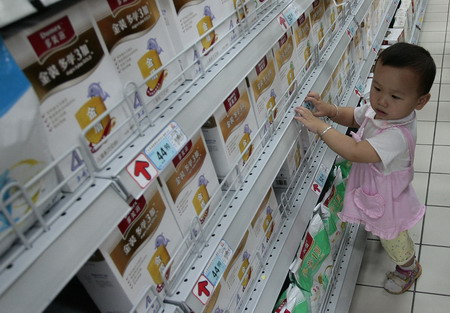
A child stands in front of imported milk powder products on shelves at a shop in Nanjing, capital city of East China's Jiangsu province. [Photo / China Daily] |
BEIJING - Rising disposable income and the desire to give their children the best of facilities are triggering a surge in baby-product sales among Chinese "baby boomers" - those born during or after the 1980s.
Buoyed by the increased consumption, manufacturers are leaving no stone unturned to cash in on the "fourth baby boom" expected to last until 2015 and are increasingly using traditional channels and the Internet to push sales.
Although the babies' and yongsters' products industry is still in its infancy, companies are now moving up the value chain to cash in on China's robust economic growth.
Like many other successful entrepreneurs, Hu Chao has seen the wheel turn a full circle. The agony of the initial years has been replaced by the sweet smell of success.
But that was not the case 10 years ago, when Hu left a comfortable and well-paid job in Silicon Valley and decided to test the fledgling e-commerce waters in China.
Thinking out of the box at that time, Hu set up a domestic e-commerce website for selling baby products. But sadly, it was a boom that was over even before it started.
Her business plan of selling diapers online should have been a cakewalk for the entrepreneur. But Hu found to her frustration that most of the online netizens were youngsters without babies, while most mothers were yet to understand the finer nuances of the Web and online shopping.
Since then, much water has flown under the bridge. Over the years Hu has built up a sophisticated and successful multi-channel retail model to sell maternity and baby products.
The tide started turning after 2005, with nearly 16 to 18 million new babies being born every year in China. The "fourth baby boom" was at its peak in 2007 and 2008, the Year of the Pig according to the Chinese calendar and the year the Olympics were held in Beijing. Young Chinese couples believed that people born during these years would be blessed with tremendous good fortune and luck.
The current baby boom is expected to last until 2015 and will see China having more than 100 million children under the age of 6 every year. In 2009 alone, 16 million babies were born, bringing the number of children aged 6 and under to around 170 million, with 70 million of these from the cities.
|
||||
The "4+2+1 family" refers to four grandparents, two parents and a child.
That in turn, has helped push revenues for baby and childcare-product manufacturers.
According to a report from Boston Consulting Group, the market value of China's baby industry alone - including food, garments, toys and related products - was around 130 billion yuan ($19.7 billion) in 2009 with an annual growth rate of 17 percent until 2012.
By 2005, the annual revenue of Leyou Dakang Technology Inc, the company set up by Hu and her husband Gong Dingyu, a former executive with Microsoft China, crossed the 100 million yuan mark.
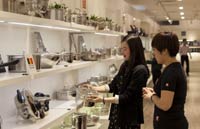
Leyou is now one of China's largest specialty retailers, selling more than 10,000 different products, including maternity dresses, diapers, milk powder, nursing bottles, toys and clothes. The company sells seven categories of products from 530 suppliers in 23 countries.
Leyou now owns about 140 stores spread across seven cities in northern China including Beijing, Tianjin, Shenyang and Xi'an.
For Leyou, the decision to shift its marketing focus from online to offline sales has proved to be lucky as the dotcom downturn of 2001 led to the closure of many e-commerce companies. In March 2001, Leyou took the first offline step by opening a store at Jiaodaokou in Beijing.
 Top 10 largest global public Internet companies
 Harvest time in Henan province
 Highlights of 10 years at Apple's WWDC
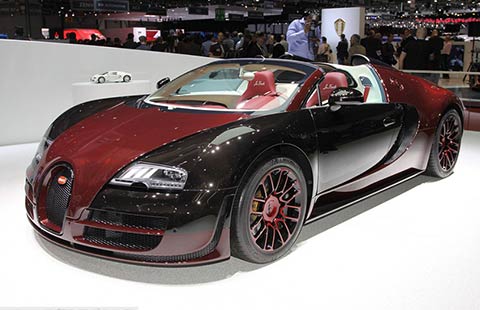 Top 10 most expensive sports cars for 2016
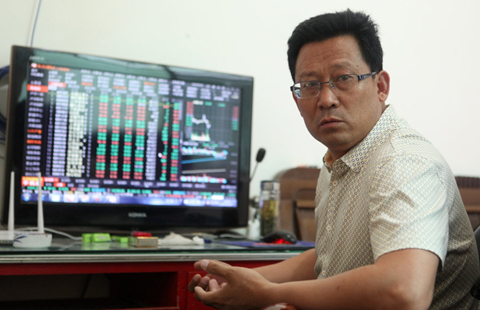 Farmers bet on the bull market
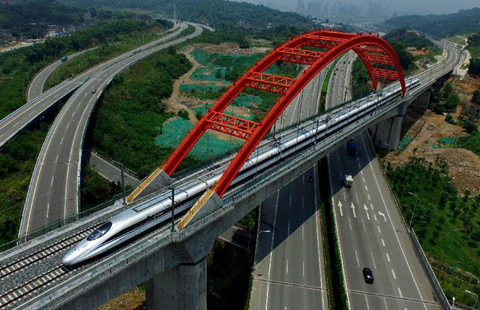 Hefei-Fuzhou railway line put into trial operation
 Top 10 largest banks in the world
 World's 15 most valuable brands of 2015

Copyright 1995 - . All rights reserved. The content (including but not limited to text, photo, multimedia information, etc) published in this site belongs to China Daily Information Co (CDIC). Without written authorization from CDIC, such content shall not be republished or used in any form. Note: Browsers with 1024*768 or higher resolution are suggested for this site.
License for publishing multimedia online 0108263 Registration Number: 20100000002731