|
 |
|
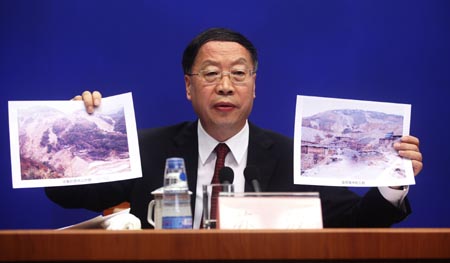
Su Bo, vice-minister of industry and information technology, shows photos of landscapes damaged by over-exploitation of rare earths at a news conference in Beijing on Wednesday. Wang Shen /[Photo/Xinhua]? |
China denied on Wednesday that it had sought political benefit or increased returns by manipulating the prices of rare earths.
Rare earths cover a group of 17 elements used to make high-tech products.
Su Bo, vice-minister of industry and information technology, said China will continue to provide rare earths to the international market, but not at the expense of the environment.
As the world's largest producer of rare earths, China provides more than 90 percent of supplies with only 23 percent of global reserves. Domestic reserves totaled 18.59 million metric tons in 2009.
The United States, the European Union and Japan lodged a complaint in March claiming that production limits put in place by China violated World Trade Organization rules.
"However, the quota was not fully used in 2011, which means that China successfully met international demand," Su told a news conference organized by the Information Office of the State Council.
China planned to export 30,200 tons of rare earths in 2011.
But actual exports were only 18,600 tons, equal to 61 percent of planned exports.
Su introduced a white paper entitled Situation and Policies of China's Rare Earth Industry, published by the office on Wednesday.
The WTO case brought by the US, the EU and Japan has more to do with politics than trade, Chen Zhanheng, director of the academic department at the Chinese Society of Rare Earths, said.
The claim by other countries that China is restricting exports is meaningless since the quota for the last year was not used up, he said.
Su said the sluggish global economy led to less demand.
However, rising prices are in line with other raw materials, Su said.
The price of iron ore in 2010 was nearly five times as much as in 2000 and prices of other raw materials, such as gold and copper, were also more than three times higher than a decade ago. The price of rare earths in 2010 was only 2.54 times what it was in 2000.
Some foreign industrial analysts questioned why China's exports of rare earths were sold for higher prices than in the domestic market.
Tariffs contribute to higher prices, Su said as did demand by foreign firms for higher quality.
"It's like an article of clothing. It could cost 10,000 yuan ($1,570) or 1,000 yuan, depending on product quality," Su said, citing industry experts.
Gao Yunhu, deputy director of the rare earths office under the Ministry of Industry and Information Technology, said China is actively cooperating with the WTO on the lodged complaint and will protect the interests of Chinese companies under WTO rules.
"The government is strengthening the management of the industry to protect the environment and resources, which is beneficial for the sustainable development of the industry and totally conforms to WTO regulations," he said.
Su stressed that China is not using environmental protection as an excuse for raising prices.
"No government in any country would tolerate such severe pollution," he said.
Local government officials in Ganzhou, Jiangxi province, which is rich in rare earths resources, said it will cost 38 billion yuan to deal with pollution caused by exploitation, according to Su.
Data show that to extract 1 ton of oxide will consume 7 tons of ammonium sulphate, which could possibly lead to long-term groundwater pollution.
The US, Canada, Australia and other countries, which also have deposits of rare earths, closed their mining projects in the 1990s because of severe environmental damage.
Chen, from the Chinese Society of Rare Earths, said that the US has 13 million tons or 13 percent of the global reserves, but due to high environmental and mining costs, it is reluctant to exploit them.
"Up to 80 to 90 percent of rare earths in Japan and the EU are imported from China and it won't change much in the long term," he said.
China is willing to strengthen communication and cooperation with countries around the world on alternatives.
According to the white paper, up to 38 companies from the US, Germany, France, Canada and Japan have invested 6.1 billion yuan in China's rare earths industry.
Reuters contributed to this story.
dujuan@chinadaily.com.cn


Copyright 1995 - . All rights reserved. The content (including but not limited to text, photo, multimedia information, etc) published in this site belongs to China Daily Information Co (CDIC). Without written authorization from CDIC, such content shall not be republished or used in any form. Note: Browsers with 1024*768 or higher resolution are suggested for this site.
License for publishing multimedia online 0108263 Registration Number: 130349