From January to April, the water quality of all sections along the eastern route's trunk canals increased to Grade III, the minimum standard for drinking water after necessary treatment, according to the State Council's Office of the South-to-North Water Diversion Project Commission.
Also, nearly 90 percent of monitored cross sections along the eastern route met mandatory water quality standards during the same period.
"For the eastern route, pollution control is the key to success as years of industrial pollution in the surrounding areas led to the extreme decline of local water quality," Shi Chunxian, an official on environmental protection of the SNWD project office, told China Daily.
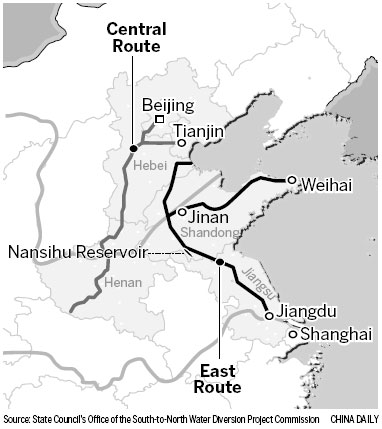
The SNWD project, the world's largest water diversion project, is designed to take water from the massive Yangtze River in the south to meet demand in drought-prone cities in the north, via three water-diversion routes.
By 2013, the project's eastern route will transfer water from Jiangdu, Jiangsu province on the Yangtze River into Shandong province along the Beijing-Hangzhou Grand Canal.
The SNWD project office has long been concerned about the contamination of water quality in the two provinces from the industrial boom, domestic sewage from rural areas and shipping on small wharves.
All of the 426 pollution prevention projects, with a total cost of 15.3 billion yuan ($2.4 billion), have been implemented to improve water quality on the eastern route, according to the SNWD project office.
"The pollution control tasks on the eastern route are the most formidable that I have ever seen," said Zhang Bo, head of the Shandong Environmental Protection Department.
The number of paper companies in Shandong was reduced by 70 percent from 2002 to 2010, while chemical oxygen demand, a major indicator used to measure water pollution, decreased by 62 percent, according to the department.
"But the closure of such a large number of companies has not caused an economic loss in the local paper industry. The current companies are highly competitive and have mostly adopted environmentally friendly technologies to curb pollution," Zhang said.
For example, paper output in Shandong in 2010 was 2.5 times larger than in 2002, he said.
Zhang said a comprehensive pollution control scheme that combines pollution management, wastewater recycling and biological environmental protection has been launched.
The recycled wastewater is now utilized for city afforestation, cleaning and agricultural irrigation, he said.
A 50- to 100-meter-wide green belt has been built around the Nansihu Reservoir in Shandong to prevent pollution.
The reservoir was once known for its severe pollution. But as of April, its water quality was close to Grade III - a dramatic improvement from "worse-than-Grade-V" in 2006, local official figures showed.
More than 200 species of birds dwell on the reservoir, while some fish that had disappeared for many years have returned.
A local resident surnamed He, who lives near a small wharf in Xuzhou, Jiangsu province, told China Daily that his quality of life has improved since the wharves closed.
"I used to close my windows to keep out the noise and coal cinder. But now those troubles are gone. A leisure square will be built soon at the original place of the wharves," he said.
"Many efforts will be made to curb pollution in rural areas in the future, such as building more small-scale sewage treatment plants to prevent any pollution incidents from occurring when the eastern route starts to supply water next year," said Guo Peng, an official in charge of environmental protection on the eastern route from the SNWD project office.
Vast amounts of water will be supplied to the country's arid northern regions within the next two years, when the first phase of the project's eastern and central routes is completed.
So far, 161.7 billion yuan, or 73 percent of its total investment, has been used, official figures showed.
jinzhu@chinadaily.com.cn


Copyright 1995 - . All rights reserved. The content (including but not limited to text, photo, multimedia information, etc) published in this site belongs to China Daily Information Co (CDIC). Without written authorization from CDIC, such content shall not be republished or used in any form. Note: Browsers with 1024*768 or higher resolution are suggested for this site.
License for publishing multimedia online 0108263 Registration Number: 130349