|
 |
|
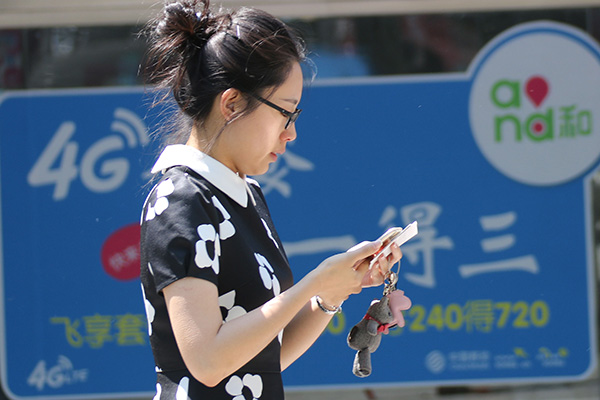
A mobile phone user walks past a logo of China Mobile's 4G service in Qingdao, Shandong province. [Photo/China Daily] |
Voice and messages make way for data as carriers search for the next big telecom idea
Editor's Note: The Communist Party of China Central Committee meets later this month in Beijing to set the course for the world's second-largest economy over the next five years. China Daily takes stock of the major economic progress achieved during the 12th Five-Year Plan (2011-15).
Less than two years after China first started getting used to fourth-generation telecom technology, the country has become the world's largest 4G market, with the biggest user population and most sophisticated networks.
Identified arguably as the brightest achievement in the national information technology sector over the past five years, the country has the goal of connecting 400 million people to 4G networks by the end of the year.
Chen Shanzhi, vice-president of Chinese telecom equipment maker Datang Group, is in no doubt about the importance of this next generation technology in telecom.
"The rapid expansion in 4G was one of the greatest successes of the 12th Five-Year Plan (2011-15)," he said.
China's ambitious 4G plan started a decade ago, when the central government was drawing its five-year national development strategy for the telecommunications sector.
Initial trials of the Time Division-Long Term Evolution technology-or TD-LTE, a 4G standard mainly developed by local telecom companies-were kicked off at the beginning of the 12th Five-Year Plan.
China pushed TD-LTE standard ahead of other widely accepted standards, hoping the self-developed technology would become a driving force for the sector.
China Mobile Ltd, the country's biggest telecom carrier by subscribers, started offering the commercial use of the TD-LTE in early 2013.
The smaller carriers, all State-owned, had to wait until the last days of that year to receive licenses to fully commercialize their 4G networks, using the European-originated LTE FDD, or Division Duplex standard.
China Mobile has dominated the domestic 4G market since then, with more than 200 million subscribers by August, according to its latest statistics.
There were more than 277 million 4G users nationwide, a 65 percent surge compared to the year before, according to statistics from the Ministry of Industry and Information Technology.
The number of 3G users, currently the largest telecom customer group, meanwhile, steadily declined as many upgraded to 4G, according to the ministry. The number of 3G users dropped more than 7.8 million in August, the steepest fall in three months.
Cao Shumin, president of the government think tank, the China Academy of Information and Communications Technology, said sales of 4G smartphones have risen at the same pace-at around 40 million a month-as has the level of mobile data traffic.
"The building of advanced telecom infrastructures in recent years has spurred an array of related sectors, and fits into the national strategy of letting the development of IT lift domestic consumption," Cao said.
Chinese customers have a growing choice of phones available, too, from the 6,000 yuan ($944) iPhone 6S to relatively inexpensive devices priced below 800 yuan.
The State Council first said in 2013 it would encourage the consumption of information via smartphones, to help expand the slowing domestic economy.
Its target was to raise public-sector and household spending on information consumption by at least 20 percent annually, through to 2015.
Gao Sumei, executive secretary of the China Information Technology Industry Federation, estimates the country's total spending on information consumption will exceed 3.2 trillion yuan this year, well above that 20 percent target growth.
Premier Li Keqiang's hard-hitting comments on the country's Internet services in April-that they were too slow, and cost too much-however, gave the pace of 4G development a significant shot in the arm.
The MIIT quickly announced plans to cut average annual mobile data charges by a third before 2016. The State-owned "Big Three" carriers also hustled to announce detailed price-cutting schemes.

Copyright 1995 - . All rights reserved. The content (including but not limited to text, photo, multimedia information, etc) published in this site belongs to China Daily Information Co (CDIC). Without written authorization from CDIC, such content shall not be republished or used in any form. Note: Browsers with 1024*768 or higher resolution are suggested for this site.
License for publishing multimedia online 0108263 Registration Number: 130349