Paulson meets China leadership on currency, trade
Updated: 2007-07-31 23:15
US Treasury Secretary Henry Paulson renewed efforts in meetings with top leaders Tuesday to persuade China to allow faster currency appreciation and wean itself off exports by adjusting consumption.
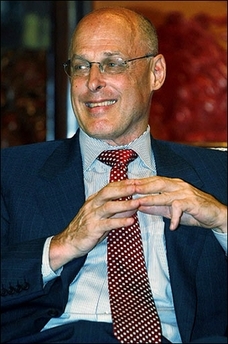 US Treasury Secretary Henry Paulson is seen during a meeting with China's Vice-Premier Wu Yi at Zhongnanhai, Beijing, China. Paulson renewed efforts in meetings with top leaders Tuesday to persuade China to allow faster currency appreciation and wean itself off exports by adjusting consumption.[AFP] |
The former Goldman Sachs chief executive met with Chinese Vice Premier Wu Yi and central bank governor Zhou Xiaochuan in the latest round of a bi-annual economic strategic dialogue between the two nations.
Paulson, who helped establish the talks in 2006 to ease trade tensions between the two economic powerhouses, is to meet President Hu Jintao on Wednesday.
His visit comes amid growing pressure to reduce the yawning US trade deficit with China and moves in the US Congress to punish Beijing for what some say are unfair trade policies.
The three-day visit began Monday in China's vast and poor northwestern province of Qinghai, where he inspected a range of environmental protection projects.
"I am sure your visit to Qinghai will deeply enrich the material you can present to Congress in future testimony," Wu told Paulson after a one-on-one meeting.
"In making this contrast, you can understand -- who could China threaten?"
The forum covers a range of economic and environmental issues but the issue at the forefront is the yuan, seen by US lawmakers as grossly undervalued to give China an unfair trade advantage.
US legislators say an undervalued yuan makes US-bound exports cheaper, thereby fuelling the trade deficit with China, which hit 232.5 billion dollars last year according to official figures.
China itself has acknowledged that its surplus, up 85.5 percent to an all-time high in June of 26.91 billion dollars, is too large and has enacted curbs, such as the abolishment of export tax rebates on July 1.
But last week, the Senate Finance Committee overwhelmingly approved a bill that requires the Treasury to identify nations with "fundamentally misaligned" currencies, potentially opening the door to economic sanctions against Beijing.
Paulson will again push the Asian giant to rebalance its export-reliant economy by boosting consumption as well as press China for a quicker pace of yuan appreciation.
"Having a currency that reflects economic reality, that is reflective of economic fundamentals, is in China's best interest," he told Xinhua news agency late Monday.
At the same time he played down expectations that China would take immediate action, saying dialogue was better than threats but it was "unrealistic" to expect the talks to erase trade tensions between Washington and Beijing.
"President Hu is going to do exactly what he believes is in the best interests of China," Paulson told reporters in Xining, capital of Qinghai.
China revalued its currency in July 2005 and Beijing has since repeatedly said it will allow the yuan to strengthen as part of overall reforms to a financial system it says would risk full collapse with a full flotation.
For China's main trade partners, the United States and the European Union, the 9.4 percent appreciation of the yuan since 2005 has come far too slowly, even though Paulson acknowledged the gains.
"The rate of appreciation has gone up considerably over the last year and the renminbi (yuan) has now appreciated well over nine percent," Paulson told reporters on the way to China.
Ministry of Commerce economist Mei Xinyu said both sides were acutely aware of the trade-gap and currency problems, but concrete results were unlikely now.
"These talks can't be taken as aiming to solve these problems but only as a way to talk about how to deal with these rather difficult people in the US Congress," Mei said.
Paulson and Wu discussed the agenda for the next full meeting scheduled for December, which comes after a key Communist party congress, where many of China's top leaders will be reshuffled for the next five-year period.
The two sides agreed that trade relations should be handled with a long term strategy in mind, Xinhua quoted China's foreign ministry as saying.
|
|
|
||
|
||
|
|
|
|