CHINA> National

|
CHINA> National
|
|
Baby boom to migrant mothers' gloom
By Shan Juan (China Daily)
Updated: 2009-06-24 10:06 Liu Yurong has been ordered by officials to return to her hometown. She has been told she must travel 1,600 km, put her job at risk and abandon her son. Why? To prove she is not pregnant.
Like the many female migrant workers who have had children, she must undergo regular tests as part of China's family planning policy, which was implemented in the 1970s to control the nation's booming population.
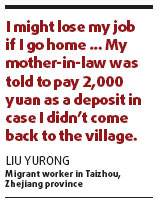
But after a rise in the number of forged documents being reported by family planning offices nationwide, she was ordered to return to be examined in person. "My boss is not going to allow me to leave," said Liu, 28, who lives with her truck driver husband and four-year-old son. "I might lose my job if I go. Also, who will take care of my son while I am away? "It would cost several hundred yuan to make the journey. I cannot afford to go back. "My mother-in-law told me family planning officials had visited several times and demanded 2,000 yuan as a deposit, which they threatened to keep if I didn't return." The law states families in urban areas are allowed one child, barring special exceptions, while in the countryside mothers can have a second child if their first was a girl. The policy has prevented 400 million births, the government said. But for migrant workers, and the family planning officials charged with keeping track of them, it is a major headache.
According to the National Population and Family Planning Commission (NPFPC), by early 2008, China had 150 million migrant workers, including about 56 million women. Of these women, at least 57 percent were of "childbearing age", effectively between 20, the legal age limit, and 45 years old. And, due to their ever-mobile nature, the government, worried the rules are being flouted, is trying expanded support projects in areas with large migrant populations. It follows findings by the NPFPC that, for the past 10 years, almost 65 percent of all "illegal" babies have been born to migrants. However, they refused to reveal how many violations there had been. "I ran a huge risk when I took my children to my home village in Anhui province for the Spring Festival," said Wu Qingxia, one of the violators, who has a son, aged five, and an three-year-old daughter. "I had to lie to my old neighbors the girl was a friend's daughter because I was not allowed to have her as my first child was a boy." Wu and her husband moved to the city of Wenzhou, Zhejiang, six years ago in the search of a better life. She explained: "As we were from outside the city, the control by local family planning authorities was relatively loose for us, so we got to have our little girl." Her story is not a unique one, according to Fan Yude, deputy director of Qinyuan county family planning bureau in Zhejiang. "People like Wu exist in every city in China with a large population of migrant workers," he said. "The family planning work situation and capacity varies from place to place, so migrants might actually not be covered or well controlled." Compared to the nation's urban population, farmers tend to hold true to the traditional preference for a male heir. They also make up a large proportion of the migrant population. People who live in cities but whose hukou is registered in their hometowns or villages must obtain temporary residency permits in any new city from the local public security bureau. This enables them to get a job, rent an apartment or start a company. To have a child, they must then report their marital status to the local family planning administration, which checks the information against a national database to prevent any violations. But due to gaps in the system, coupled with the frequent migratory habits of workers on short-term contracts, it is by no means foolproof. Zhang Meijuan, a family planning official for Beijing's Shijingshan district, said: "In my patch, there are 20 residential communities with large concentrations of migrant workers, and it takes us almost a week to finish collecting and confirming reproduction details in one community. But when we go back a short time later, the people are already gone. "This means the information on the database is often out of date. Our recorded information changes every two to three months." |
主站蜘蛛池模板: 芦山县| 平度市| 黄石市| 修武县| 屏边| 陈巴尔虎旗| 囊谦县| 沈阳市| 洛南县| 丽水市| 宁远县| 太保市| 津市市| 清河县| 南靖县| 东莞市| 固原市| 南木林县| 济宁市| 兴国县| 盘山县| 凤翔县| 雷州市| 镶黄旗| 淳化县| 正定县| 南漳县| 离岛区| 逊克县| 谢通门县| 民权县| 建阳市| 沾化县| 涡阳县| 镇江市| 和静县| 固原市| 三明市| 宁海县| 阿克陶县| 德安县| 兴海县| 沂源县| 和硕县| 朝阳区| 安图县| 大方县| 江津市| 安乡县| 旌德县| 望都县| 龙陵县| 娄底市| 鱼台县| 临西县| 辰溪县| 靖安县| 东乌珠穆沁旗| 曲周县| 怀宁县| 冀州市| 双流县| 繁峙县| 淮阳县| 城口县| 桂东县| 波密县| 监利县| 柳河县| 赤城县| 红安县| 广宗县| 高雄县| 安化县| 寻甸| 任丘市| 义乌市| 清丰县| 玛纳斯县| 孟连| 临夏县| 玉门市|