CHINA> National

|
CHINA> National
|
|
Baby boom to migrant mothers' gloom
By Shan Juan (China Daily)
Updated: 2009-06-24 10:06
Hospitals are also required to update the database with details of births and maternity examinations. Zhang added: "Sometimes, after a hospital has reported a female migrant from my area is pregnant or has given birth and I went to their home to offer health information and support, there is no one at the registered address."
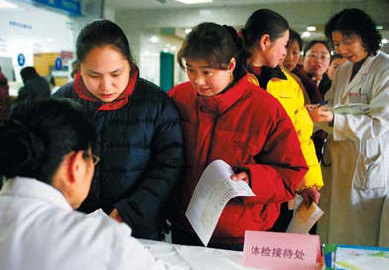
On the subject of Liu Yurong in Taizhou, whose relatives had to hand over cash to officials in case she failed to return, he said: "I don't agree with such a practice, but I somewhat understand their (the family planning official's) desperation. Some migrant workers just send back fake pregnancy tests to fool officials in their hometowns." Regulations can change slightly from province to province and, in some, married women who cannot legally have a second child and live outside of their village or town of origin must take three pregnancy tests a year, with the results sent home, said Zhai. However, some authorities require them to appear in person. "It has caused problems, but complaints from migrants about the actual implementation of family planning policy itself are even higher," said Pan Guiyu, deputy director of the China Family Planning Association. Fei Junxia and husband Lu Men, both from Sichuan province and in their late 20s, are expecting their first child in February. But despite being two months into her pregnancy, she has to travel back to her village from Beijing for a "birth permit" in order to get a public hospital bed in the capital. "I'm pregnant, but still I have to travel," she said. "My friend didn't bother to go back for the permit and had to deliver the baby in a private low-quality hospital, which put her health at risk." For Zhai and Pan, the problem lies not with the policy but with the challenges faced by the various local family planning authorities in sharing information and making sure it is accurate.
 "As well as enforcement, the government should also be focusing on support services for these migrant workers," added Pan. Those who break the family planning laws face a fine of up to 10,000 yuan. But Zhang in Beijing said the threat of punishment has failed to prevent violations, mainly as it is difficult to collect the money. "Over the years, we've discovered that the key is to balance the reproductive control and service," she said. "Simple administrative measures and coercion do not work nowadays. Instead, we have to assure migrants of good service and support. Only then will they truly feel obligated to follow the policy. "Now we solicit involvement from volunteers within the floating population and register each new arrival in the community and every exit. Our workers and volunteers regularly distribute contraceptive devices and handouts carrying information on reproductive health, as well as organize free maternity and health checks for migrants. We also give them support with job information, child education and administrative convenience." To ease the burden on migrant mothers, they will soon be able to receive free contraceptives and support services in their city of temporary residence thanks to a new regulation to come into effect on Oct 1. It will hopefully mean women like Liu will not have to take on mammoth journeys for a pregnancy test. "We will be setting up pavilions in target areas, such as neighborhoods, factories, and markets, to raise awareness of the new rules," said Zhang. For some of those who left the countryside behind for a life in the city, though, habits are changing fast. Li Hongfang, 34, was born in Henan province but has worked as a maid in Beijing for five years. Her first child was a girl but she says she has no interest in trying for a boy, despite being legally entitled to. "My husband can earn more than 2,500 yuan selling vegetables here, so I just want to earn more money to give my daughter a good education," said Li, who makes 1,200 yuan a month. The couple's nine-year-old daughter lives with her grandparents in their home village, where the average annual income is just 4,000 yuan. "When we've saved enough money we'll bring them here and never go back," she said. "In cities, we don't need to work hard on the land, so a girl and a boy are the same."
|
主站蜘蛛池模板: 秭归县| 青浦区| 潼关县| 宜君县| 天津市| 农安县| 丰顺县| 广昌县| 德州市| 清苑县| 汶上县| 宝兴县| 温泉县| 桐城市| 岑溪市| 乐至县| 阿勒泰市| 万山特区| 昌邑市| 延边| 张掖市| 泗水县| 潞西市| 公主岭市| 比如县| 永城市| 龙陵县| 呈贡县| 西吉县| 子长县| 射洪县| 福安市| 宜阳县| 阿拉善右旗| 同心县| 海安县| 鄂伦春自治旗| 遵义市| 耒阳市| 五台县| 沂水县| 保靖县| 凤翔县| 阜阳市| 广元市| 高清| 吉林省| 普安县| 潢川县| 贺州市| 车致| 敖汉旗| 美姑县| 巴林右旗| 连州市| 砚山县| 泾川县| 乐亭县| 星子县| 汕尾市| 新龙县| 佛冈县| 双桥区| 武穴市| 吉林省| 香河县| 安龙县| 宜丰县| 巨鹿县| 大兴区| 红安县| 昭苏县| 习水县| 青铜峡市| 武定县| 锡林浩特市| 合肥市| 赤壁市| 华蓥市| 丽水市| 日土县| 登封市|