Economy
China holds to WTO vow on tariffs
By Xin Zhiming (China Daily)
Updated: 2009-12-17 08:11
 |
Large Medium Small |
The import tariff for fuel oil will be raised to 3 percent and bumped to 6 percent for jet fuel next year, an increase by the Chinese government of 1 percent for both products that could influence domestic oil prices.
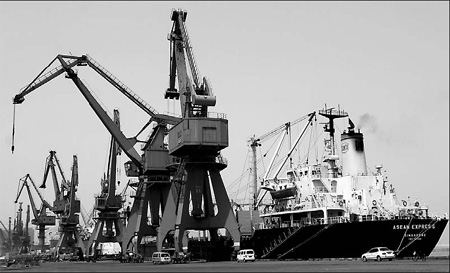 A foreign oil tank docks at a port in Lianyungang, East China's Jiangsu province. [Xie Zhengyi]? |
China will also cut a number of import tariffs to meet its World Trade Organization (WTO) commitment it made upon joining the organization in 2001 as it strives to restructure its economy.
"It is highly significant," said Jia Kang, director of the Institute of Fiscal Science, Ministry of Finance. China's market economy status has not been recognized by all nations and its fulfilment of its WTO commitment will help this status be recognized by more countries, he told the press.
The hike in fuel oil taxes will deal a further blow to importers after the country levied a heavy consumption tax on the product, used to power ships and energy plants, because the production cost of the country's fuel importers will rise, analysts said.
They said the new duties could have an impact on domestic prices of the products.
The Ministry of Finance announced yesterday that it will also lower export duties for unwrought molybdenum and molybdenum powder to 5 percent next year, from 15 percent and 10 percent, respectively, this year.
Moreover, export taxes on unwrought indium, indium scrap and indium powder will be reduced to 5 percent in 2010, from this year's 10-15 percent, according to a list of tax changes posted on the ministry's website.
China announced on Tuesday that it will lower import duties on more than 600 products next year, including coal, naphtha and phosphate ore.
As a result, China's overall import tariff level would be reduced to 9.8 percent next year, with that of agricultural products cut to 15.2 percent on average and industrial products to 8.9 percent.
But Wang Lengyi, researcher with the Shanghai Academy of Social Sciences, said China has paid a dear price in fulfilling its WTO promise. In 2004, for example, China for the first time since the 1980s became a country suffering from agricultural trade deficit.
The tariff-cutting move is also part of the country's effort to build an energy-efficient economy by encouraging the import of resource products, analysts said.
China has kept import duties for naphtha, a feedstock for petrochemicals, at 1 percent for next year. And the change in tariffs does not cover main transportation fuel gasoline and diesel, with a duty of 1 percent since 2008 versus 5-6 percent previously.
It will also cut import tariffs on rubber in 2010, helping domestic tire-makers that have enjoyed increasing demand from soaring Chinese car production.
The import tax on natural rubber will fall 23 percent to 2,000 yuan per ton, while the tax on higher-value rubber smoked sheet will fall 38 percent to 1,600 yuan per ton, the Ministry of Finance said yesterday.
"We might import more in the coming months, but we will first calculate our cost, considering the demand and natural rubber prices in the global market," said Sheng Liang, a trader with Qingdao International Rubber Exchange Market.
Agencies contributed to the story