Government and Policy
Green plans on track, NDRC says
(China Daily)
Updated: 2009-12-31 07:27
 |
Large Medium Small |
Nation to curb overcapacity, develop low-carbon economy
China is making concrete efforts toward a low-carbon economy by curbing overcapacity and boosting strategic emerging industries, a senior official at the nation's top economic planner said yesterday.
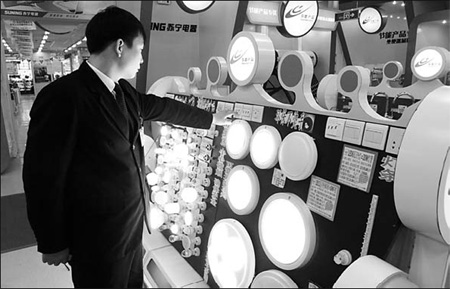 An employee looks at energy-saving lights at a Suning appliance store in the Anzhen community in Beijing on Sunday. [Da Wei] |
Li Ningning of the National Development and Reform Commission (NDRC) said the overcapacity problem in a few sectors such as the coal chemicals industry must be tackled head on.
| ||||


In 2009, the production capacity of coke expanded by 30 million tons, while exports were down 96 percent from a year earlier to 480,000 tons. The capacity utilization rate 80 percent in 2008, he said.
"China is a country comparatively rich in coal, but lacks oil and gas. The absence of mature technology and the low investment threshold in the coal chemical industry means it is conducive to further investment," said Li.
Restructuring of the coal chemical industry involves eliminating outdated coal chemical production capacity, supporting technological innovations and strengthening policy guidance, according to Yuan Longhua, an official from the Ministry of Industry and Information Technology.
Wang Jian, secretary-general of the China Society of Macroeconomics, had written in an article published by the Xinhua-run Outlook Weekly that 17 industries in China faced excess capacity in 2008, rising from 11 in 2005. And the number of industries with excess capacity was still rising, Wang added.
Premier Wen Jiabao told Xinhua on Sunday that overcapacity was the result of an imbalanced economic structure in China.
"To resolve the problem of overcapacity, the most important thing is to take economic, environmental, legal and, if necessary, administrative measures to eliminate backward capacity and, in particular, restrict the development of energy-consuming and polluting industries with excess capacity," Wen said.
During the press conference yesterday, Shi Lishan, another official with the NDRC, said the government needed to develop hi-tech industries such as wind and solar power equipment manufacturing as China rushed to build a low-carbon economy.
Earlier this month, Premier Wen had listed seven hi-tech emerging industries - new energy, energy-saving and environmental protection, electric vehicles, new materials, information industry, new medicine and pharmacology, as well as biological breeding.
Boosting low-carbon technologies was crucial for the transformation of the nation's economy, Wen said.
Of the seven emerging industries that needed particular attention, new energy, energy-saving, environmental protection and electric vehicles industries were on the government's priority list.
By the end of 2008, China's energy-saving and environmental protection industries totaled 1.55 trillion yuan ($227 billion), accounting for 5.17 percent of the country's GDP, according to the NDRC.
He Bingguang, another NDRC official, forecast at a forum on low-carbon economy held in Beijing last week that due to government policies the two industries would account for 7 to 8 percent of China's gross domestic product (GDP) by 2015.
In fact, financing of low-carbon industries has been part of the government's stimulus package.
Liu Mingkang, chairman of the China Banking Regulatory Commission, said Chinese banks would continue to play a positive role in energy conservation and environmental protection, as well as helping to adjust the economy's structure.
"Banks should be part of concerted efforts to make a low-carbon economy," he said at a financial forum here last week.
To control risks, banks should create more low-carbon financial products to benefit the "green economy", Liu said.
Xinhua