271 injured in Shanghai's subway crash
Updated: 2011-09-28 07:38
By Wang Zhenghua and Shi Yingying (China Daily)
|
|||||||||||


Latest:
A total of 271 people have received treatment in hospitals, said Xu Jianguang, director of Shanghai's health bureau, at a press briefing late Tuesday.
'Darkest day' in Shanghai's subway history as signal system blamed
SHANGHAI - Signal failure is being blamed for a subway train crash that injured more than 270 passengers on Tuesday.
|
 |
Sun Jianping, the traffic bureau chief, promised that authorities will conduct a thorough investigation into the accident.
"Independent experts will be invited to join the probe," he said during the news conference.
An investigation team, led by the city's work safety department, has been set up.
The team declared on Tuesday night that operations on Line 10 will be suspended for an unspecific period of time starting on Wednesday as part of the investigation.
According to media reports, the signaling equipment was the same as that used when a bullet train crashed into a stalled train in July in Wenzhou, Zhejiang province, killing at least 40 people.
Tuesday's accident occurred at about 2:50 pm when a train on Line 10 also crashed into a stalled train in the tunnel that links Laoximen and Yuyuan Garden stations. The line goes under several scenic spots, such as Nanjing Road and City God Temple.
Reports suggest that problems before the crash with signaling equipment had forced a switch to manual operations.
Sun Zhang, a professor of Tongji University and the Urban Mass Transit Railway Research Institute, said that the accident was linked to a faulty signal system, according to the Xinhua News Agency.
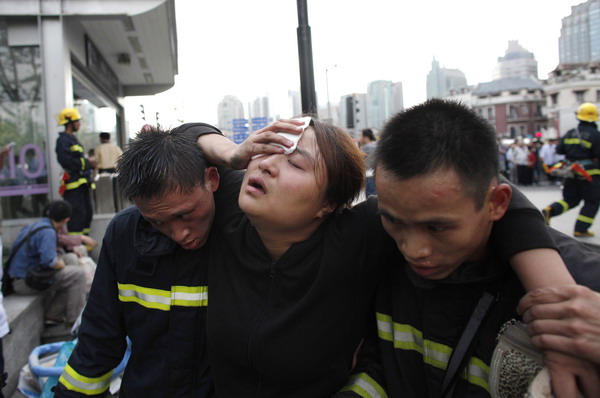 Rescue workers assist an injured woman outside Yuyuan Garden Station after a subway train crash in Shanghai on Tuesday. [Photo by Carlos Barria/Reuters]
|
"There must be a severe fault in the signal system," Sun said.
Manufacturers, Casco Signal Ltd, a joint venture between Alstom Transport and the CRSC Group, have been involved in more than 28 subway signaling projects across China, including lines in Beijing and Shanghai.
The accident cast a shadow on the safety of China's fast expanding subway network.
The subway operator, Shanghai Shentong Metro Group, apologized on its official micro blog for the accident, and described the day as the "darkest in Shanghai's subway history".
Yu Guangyao, president of Shentong Metro, said the group had conducted safety checks and tests along the line following the crash and its safety could be guaranteed.
Traffic on Line 10 resumed at around 7 pm at a reduced speed of 45 km/h.
Most of the injured suffered broken bones, cuts and abrasions, said Zhao Gang, the director of the emergency department at Shuguang Hospital.
Carriages in both trains were stained with blood.
|
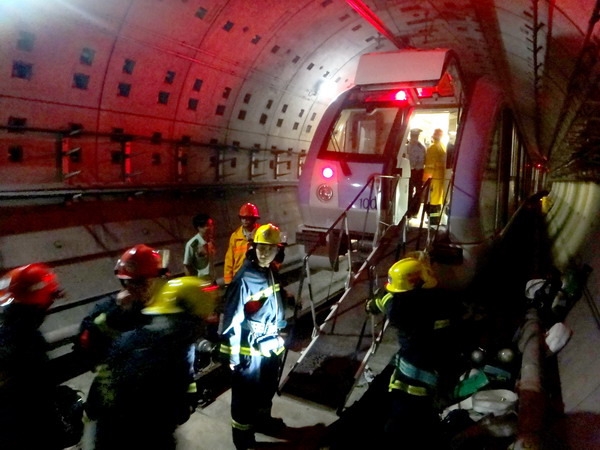 Rescuers ensure that the injured have been taken to safety following the Shanghai subway crash on Tuesday afternoon. [Photo by Gao Erqiang/China Daily]
|
Shards of broken glass from smashed windows, shoes and personal belongings littered the floors of the carriages.
The driver of the ongoing train managed to apply the emergency brakes preventing a more serious accident.
About one hour after the accident, passengers were still seen walking out of Yuyuan Garden Station, most of them on their own. They included senior citizens and young parents carrying babies in their arms. Some were injured, with bleeding cuts on their heads and faces.
At least four foreigners were among the injured. Ivar Moesman, from Norway, said that his train waited for about 20 minutes at the station before it left Yuyuan Garden for Laoximen.
German woman Natina Frischmann, traveling in the same train, said everybody stumbled when it suddenly stopped.
"Some people were bleeding but it was quiet in the carriage," she said. After about 20 minutes the public address system asked people to stay calm and follow instructions, she said.
"The train was not as crowded as during rush hour, but there were still a lot of passengers," said Jiang Yuhua, a middle school student.
"The crash was so violent that it was impossible to hold onto the hand rail," said another passenger.
Under the instruction of emergency workers, passengers walked hundreds of meters in the dark tunnel to safety. Many were crying.
Sixty-two ambulances arrived at the scene to ferry the injured to six hospitals.
Incidents have occurred on the subway before.
On Dec 22, 2009, tens of thousands of commuters were trapped for four hours and at least another million were delayed after two trains collided on Line 1, the busiest subway route in the city.
Casco was investigated after the accident, but no result has been released.
On July 28, a train on Line 10 headed in the wrong direction before the mistake was detected.
The operator said later that the accident was caused by the dysfunction of communication-based train control technology (CBTC) signals during tests for upgrades.
Shentong Metro's Yu said that Casco had promised to fix the faulty signal system. "Despite their promise, the signal problems reoccurred."
Information on Casco Signal Ltd's official website shows that the company imported the Urbalis888 CBTC, an automatic train control system based on high-speed wireless communication technology, from its parent, Alstom Transport.
Apart from Line 10 in Shanghai, the system has been used in Beijing's subway Line 2 and the line linking the airport with the downtown area.
Shanghai opened its first metro line in 1995 and currently has 11 lines, covering more than 420 km, carrying nearly five million passengers a day, according to figures from the operator.
China is also pouring money into its urban underground networks, with nearly two dozen major cities given the green light in late 2009 to build 89 metro lines by 2016 - at an estimated cost of 880 billion yuan ($134 billion).
Li Xinzhu contributed to this story.
Related Stories
Shanghai subway rescue underway 2011-09-27 18:16
Two Shanghai subway trains collide 2011-09-27 17:04






Hot Topics
Libya conflict, Gaddafi, Oil spill, Palace Museum scandal, Inflation, Japan's new PM, Trapped miners, Mooncake tax, Weekly photos, Hurricane Irene
Editor's Picks
|

|
|
|

|

|