Defense budget to grow 12.7% to $91.5 billion
(Xinhua)
Updated: 2011-03-04 11:32

|
|
BEIJING -- China said Friday it plans to raise its defense budget by 12.7 percent to 601 billion yuan ($91.5 billion) in 2011, compared with an increase of 7.5 percent last year.
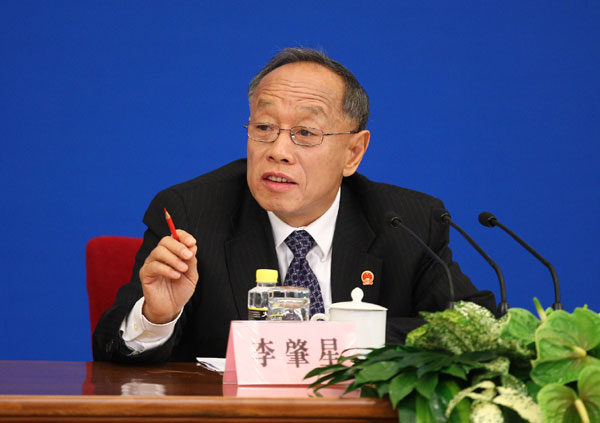
The year's draft defense budget was 67.6 billion yuan more than 2010, and accounted for about 6 percent of the country's total budget, said Li Zhaoxing, spokesman for the annual session of China's national legislature.
|
|||||||


The former foreign minister said China's defense expenditure is transparent and defensive in nature.
"There is no such thing as a so-called hidden military expenditure in China, and the budget is subject to auditing from the government and military," he said.
The bulk of the spending goes towards moderately improving armament, military training, human resource development, infrastructure of grassroots units and the living standards of the servicemen, said Li.
China's defense budget is almost evenly divided in three parts -- the living expenditure of the servicemen, expenses for training and maintenance, and spending on equipment, said Major General Luo Yuan, a researcher with the Chinese People's Liberation Army (PLA) Military Science Academy.
Defensive and transparent
"The limited military strength of China is solely for safeguarding its national sovereignty and territorial integrity and would not pose a threat to any country," said Li.
"China is committed to peaceful development and a national defense policy that is defensive in nature," the spokesman said during a press conference.
Compared to the world's average, China's military spending is low given its 1.3 billion population, vast land and long coast lines, and its ratio of military spending to gross domestic product (GDP) is lower than many countries, Li said.
While China's military spending amounts to about 1.4 percent of its GDP, "that ratio in India is much higher than 2 percent," said Li in response to a question from an Indian journalist.
China's military spending is dwarfed by that of the United States which, at $725 billion, accounted for about 4 percent of the country's GDP for the 2011 fiscal year, said Luo.
"It is natural for China's defense budget to slightly fluctuate, as it is impossible to always rise at a high rate," said Luo.
To some extent, the increase in military spending was made to keep pace with the rising consumer price index (CPI), said Luo.
Moderate and sufficient
The modest growth in military expenditure in China may also be the result of the country's need to prioritize domestic spending, both to rebalance societal incomes among classes and geographies and to protect against international economic disruptions, said Robert Lawrence Kuhn, a renowned expert on China from the United States.
Kuhn, author of "How China's Leaders Think," also attributed the modest increase to "recognition of significant improvement in defense technologies and systems for defensive purposes."
"Indeed, in today's hyper-complex world, a broader definition of 'national security' includes economic and social requirements in addition to traditional defense needs," Kuhn told Xinhua in an email.
"As a major developing country, China's national defense spending has always been maintained at a moderate and sufficient level," said Luo.
"Moderate" means China would not raise its military spending merely for the purpose of boosting the scale, while "sufficient" means the spending has to meet necessary demand for national defense, said Luo.
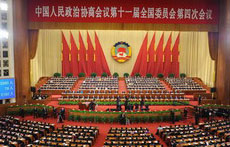
The defense figures came one day before the annual session of the National People's Congress, which sets out government policy for the coming year.