Activists hope to thwart bear bile user's IPO bid
Updated: 2012-02-11 09:20
By Jin Zhu and Tan Zongyang (China Daily)
|
|||||||||


Drug firm that makes traditional medicine with bear bile would use funds to keep more animals
FUZHOU - A pharmaceutical company in Fujian province that makes medicines from bear bile has again been targeted by animal rights activists as it makes a second attempt to become publicly listed.
Guizhentang Pharmaceuticals, founded in 2000, extracts bile from captive bears to make traditional Chinese medicines. The company keeps 470 bears and hopes to increase the number to 1,200, according to its website.
Bai Yipeng, founder of China SOS Help, a non-government organization whose activities include advocating for animal rights, said on Wednesday he had formed an alliance with others to buy shares of the drug company in order to stop it from going public.
Guizhentang could raise up to 120 million yuan ($19 million) with the initial public offering, Bai said, more than twice the estimated value of its first IPO attempt - 50 million yuan - last year, according to China Securities Journal.
On Feb 1, the China Securities Regulatory Commission released a list of 220 companies awaiting approval by the Growth Enterprise Board to trade on the Shenzhen Stock Exchange. Guizhentang was one of them.
|
|
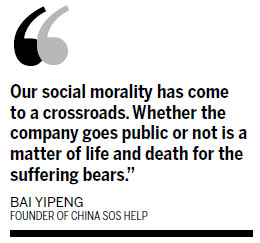
"Our social morality has come to a crossroads. Whether the company goes public or not is a matter of life and death for the suffering bears," Bai said on his micro blog on Wednesday. He added that the fundraising would help the company expand its farm where the bears are kept and increase the number of bears in captivity.
Bai said he had sent the tender offer to three big investors in the drug company, and it might be received in one or two days. He hoped those shareholders would make the "right" decision by accepting the offer within 10 days.
"If we succeed in buying enough shares as a large shareholder with a right to veto business decisions, we will strategically make the drug company diversified in its production and abolish bile extraction from bears," he said.
The company said it hasn't got the offering proposal from any individuals or activist groups yet.
"So far we haven't received documentation from Mr Bai about the proposal to buy shares," said an employee surnamed Xu in the company's administrative office.
Xu said he couldn't say whether opponents will stop the company's IPO plan or not, and that he would need permission from the company's senior executives, who can't immediately be reached for comment.
Guizhentang's attempt to go public last year triggered furious protests from animal rights groups and netizens who accused it of cruelty in the captive breeding of bears and method of bile extraction. The company argued that the method was legal and has replaced the traditional method, which was to first kill the bears.
On its website, Guizhentang says it can collect bile in five to eight minutes without causing the bears pain.
The company is expected to use the funds raised by the IPO to expand the size of its farm and the number of its bears to 1,200.
Guizhentang is not the only drug company extracting bear bile for medicines. Another such pharmaceutical company, Kaibao Pharma Co in Shanghai, was listed in January 2010.
"The company's move got the attention of animal activists several months later. There were not so many people concerned about the practice of extracting bear bile at the time," said Zhang Xiaohai, director of external affairs of Animals Asia Foundation's China Office, which is based in Hong Kong.
"But now, we (the foundation) are inspired, because more people are concerned not only about the cruelty, but also related industries," he said.
Bear bile has been used in traditional medicine in China and other Asian countries because it is thought to have benefits, such as detoxification, cleansing the liver and improving vision.
In the 1980s, captive breeding replaced the original method of killing wild black bears to get the bile.
By 2006, China had 68 registered bear farms where about 7,000 black bears were kept for bile extraction, according to the State Forestry Administration.
The number of bear farms increased to 98 in 2011.
Bear farms can now be found in 11 provinces, such as Jilin, Heilongjiang, Sichuan, and Yunnan, according to the foundation.
Medical professionals say bears are subjected to crude surgery that leaves permanent wounds in the abdominal wall and their gall bladders, causing serious diseases and even killing many of the animals.
As parts of its efforts to end bear farming in China, the foundation has rescued 277 black bears from farms in the past 10 years.
As of January, 111 of the rescued bears had later died, and 38 percent of those from liver cancer, according to the foundation.
"The bile extracted from the sick black bears is very likely to carry a cancer cell, which could trigger health risks when ingested by humans," said Wang Shengxian, head of the pathology department at Chengdu Military General Hospital.
"Years of research showed that we can produce drugs with substitutes that have the same properties as the drugs with bear bile," said Jiang Qi, former vice-president of Shenyang Pharmaceutical University.
So far, government authorities have not approved the substitute drugs for sale on the market, Jiang said.
Related Stories
Drug firm draws fire from animal rights activists 2012-02-10 16:13
Drug firm's use of bile, IPO plan under fire 2012-02-07 13:36






Hot Topics
Kim Jong-il, Mengniu, train crash probe, Vaclav Havel, New Year, coast guard death, Internet security, Mekong River, Strait of Hormuz, economic work conference
Editor's Picks
|

|
|

|

|

|