Legislators seek changes for migrants
Updated: 2012-02-25 09:51
By Chen Xin (China Daily)
|
|||||||||


Suggestions include more training for skilled jobs
BEIJING - More education and other public resources should be offered to the new generation of migrant workers to ensure their job security and ability to get by in cities, the country's legislators are suggesting.
 |
|
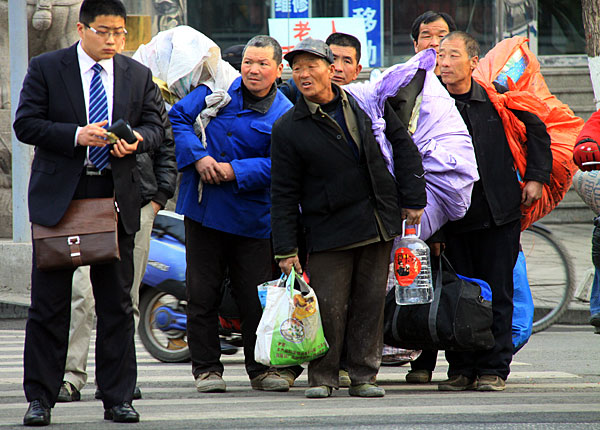
Migrant workers carrying packages wait to cross the street in Ji'nan, Shandong province, on Wednesday. [Photo by Chen Ning / for China Daily] |
"I've noticed that young migrants frequently change jobs, which is not good for themselves, or enterprises, or even the labor market," Yan Chengzhong, a National People's Congress deputy, said ahead of this year's sessions of the NPC and the Chinese People's Political Consultative Conference, which will begin in the first week of March.
A recent survey by Tsinghua University supports Yan's comment.
 |
China has around 240 million migrant workers, and 58 percent of them were born after 1980.
Yan, who is an economics professor at Donghua University in Shanghai, said most young migrant workers never farmed in the rural areas they came from, but left to find jobs in cities right after finishing their middle school or high school education.
Young migrants have high expectations, and most want to ultimately become urban residents. They ask for a better living and working environment than their parents have, according to Yan.
Yue Shaojie came to Beijing from North China's Hebei province in 2006 and works at a real estate agency.
Yue said he had at least five different jobs in the past five years, for example as a guard, street vendor, electrician and construction worker.
"I want better work that can pay more and provide more chance for me to develop myself," the 24-year-old said.
"Migrant workers are normally employed in construction and service industries that require little skill. They should be given more training to help them better adjust to the current labor market, where many companies are thirsty for skilled workers," Yan said.
About three-fourths of migrant workers have no training in skilled professions, according to a report in 2006 by a research institute under the State Council.
"That migrant workers lack training has not changed in recent years," said Zhang Quanshou, another NPC deputy who is also board chairman of a human resources company in Shenzhen, South China's Guangdong province.
"Skills determine migrant workers' income and mean stable employment for them. To be a migrant worker should not automatically mean being an unskilled laborer," he said.
Zhang said many vocational schools provide training that does not match companies' needs and many workers attend just to get a certificate.
"Vocational schools should collaborate with businesses to jointly train migrants to meet market demand," he suggested.
Wang Lingyi, a researcher at the Shanghai Academy of Social Sciences, said the government plans to increase education spending from 3.66 percent of the country's GDP in 2010 to 4 percent this year, and he suggests some of that money go toward skill training for migrant workers.
"Migrant workers should get more free or subsidized training led by the government. Training should be tailored to meet both employers' demand and the country's goal of upgrading industry," he said.
Wang said more public services should also be offered to migrants to help them better settle in cities.
Housing, pensions, healthcare and children's education are major concerns for migrant workers in cities, and they want to enjoy those public services just as urban residents do, he said.
"Those public services should be gradually opened to migrants. But the biggest problem is to break the restrictions brought by hukou (permanent residence permit)," said Wang.
In Beijing, people without local hukou are not allowed to buy apartments or to register cars unless they have paid personal income tax or paid into social security accounts in the city for five consecutive years.
Zhang Yi, a labor economics expert at the Chinese Academy of Social Sciences, said it would be possible for small and medium-sized cities to drop hukou restrictions for migrants, but it's not that easy for Beijing and Shanghai.
"Big cities are pondering how to limit their already big populations, but smaller cities ought to tailor their industrial development plans and hukou policies to attract migrants to help with the cities' development," he said.
Premier Wen Jiabao said in the 2011 government work report in March that the government would make efforts to transform migrants who have lived in cities for a certain amount of years into urban dwellers, according to each city's situation.
The State Council posted an announcement on its website on Thursday, saying that China would continue to reasonably limit population in big cities. But, it said, migrants who have been employed at a stable job for three years in county or lower level cities and towns, have a place to live (including rental apartment) and have paid into social security accounts for a certain period can apply for local hukou.
Related Stories
Migrant worker life hard on marriages 2011-05-06 07:38
Legal resources urged for migrant workers 2011-07-09 07:56
Survey reveals misery of migrant workers 2011-12-31 16:21
Jobless migrant workers sleep rough 2011-08-04 13:07








Hot Topics
Wu Ying, iPad, Jeremy Lin, Valentine's Day, Real Name, Whitney Houston, Syria,Iranian issue, Sanyan tourism, Giving birth in Hong Kong, Cadmium spill, housing policy
Editor's Picks
|
|

|

|

|

|