|
|
|
 |
|
|
|||||||||
When Gao Jun moved to Beijing to attend university in 2006, one of the first things he bought was a secondhand bike.
"As a student with no income, I found a bicycle was the most convenient way of getting around," said Gao, 26, now a graduate student at the Beijing Foreign Studies University. "It also allowed me to give my roommates a ride to class."
|
 |
|
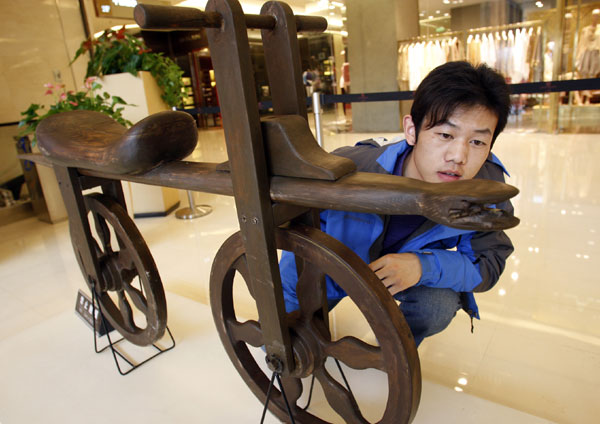
A man admires a wooden bike dating from the 1790s at the Beijing Bike Week exhibit, which opened on Thursday. The bike, without pedals, is propelled by a rider pushing it forward with his legs. Zhang Wei / China Daily |
"Unlike ordinary bicycles, which many people think merely serve travel purposes, fixed-gear bikes are fancy and fashionable," said Gao, a native of East China's Shandong province. Fixed-gear bikes, which have neither gears nor brakes, have become a hot commodity among young Chinese who value their ride's sleek, modern look.
These consumers are foremost in the mind of Shannon Bufton, an Australian cycling enthusiast and former urban designer who is working to preserve Beijing's cycling culture.
"To me and many other foreigners, the image of Beijing is synonymous with the bicycle, much like Venice is with the gondola. Beijing and the bicycle go together - at least they used to," Bufton, 35, said.
Back in the 1980s, about 80 percent of Beijing's population relied on bicycles for transportation, and foreign visitors saw bikes swarming the city streets. In the 1990s, as China's economy grew, the Chinese began buying cars and the bicycle's popularity began its steep decline.
Now, China is one of the world's top automobile-buying countries. Because the Chinese associate bicycles with a bygone era, as well as hardships, Bufton decided it would help bring back the bicycle culture by burnishing the bicycle's image.
"We want to bring back the bicycle as part of the city's culture by repositioning its image as a modern, smart and a desirable object no longer a symbol of poverty, a cheap tool for commuting," he said.
"Now, many more Chinese are riding for leisure and fashion, and maybe recreational cycling is a way to keep the bicycle as part of their lives."
One of the ways he thought to spread this message is through Beijing Bike Week. The inaugural, four-day event, which began on Thursday, includes a bicycle race, workshops and a bike exhibition.
The exhibition, held on Beijing's Financial Street, features high-end brands such as Look (France), Cervelo (United States) and BMC (Switzerland). BMC even has a replica of the carbon fiber bike that Cadel Evans rode to victory in last year's Tour de France.
Some of the models on display cost at least 100,000 yuan - a price tag that reflects changes in the market and consumer's tastes.
"We used to sell our professional bikes to the national and provincial athletic teams," said Huang Peng, marketing manager of Beijing Holy Brother, who is in charge of Look's marketing.
"But since recently, we have been receiving more individual orders, particularly those for recreational purposes," he said.
To remind the public that bicycles once held a lofty position in Chinese daily life, the Bike Week organizers incorporated six historical bikes into their exhibition. The bikes, all on loan from the China Bicycle Museum in Bazhou, Hebei province, include one owned by China's last emperor Puyi (1906-67).
The single-speed, cruiser bike with mustache handlebars was manufactured in Germany in 1912, under a brand called "Blue".
Puyi used that bike in the 1920s, a decade after abdicating from the imperial throne, said Zhang Weimin, curator of the bike museum. The museum acquired it in 2008 from a Beijing bicycle collector.
Among the historical bikes is also the Tianjin-made Shuangyan, produced in the early days of the People's Republic of China. It was nicknamed the "Big Iron Donkey", and it was very popular among ordinary citizens at the time.
"The decline of the bicycle in Beijing is the opposite of the experience in other parts of the world," Bufton said.
Contact the writers at Zhengxin@chinadaily.com.cn and tiffanygtan@gmail.com
Wu Ying, iPad, Jeremy Lin, Valentine's Day, Real Name, Whitney Houston, Syria,Iranian issue, Sanyan tourism, Giving birth in Hong Kong, Cadmium spill, housing policy
|
|
|
|
|
|