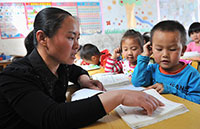
-- Proactively developing pre-school education. The goal is to have 65% of the children who will be starting school in three years enrolled in kindergartens, and 85% of the children who will be starting school in one year enrolled in kindergartens. During the 12th Five-Year Plan period (2011-2015), the central government will appropriate 50 billion yuan for pre-school education development in rural areas of central and western China. Local governments at different levels will carry out the Pre-school Education Three-Year Action Plan and gradually build and improve pre-school education networks in urban and rural areas.
-- Quickening steps in making senior high school education universal. China will improve the conditions of senior high schools, and enhance their teaching level and quality. By 2015, the gross enrollment rate of senior high schools will reach 87%. Moreover, more support will be given to senior high schools in poor areas of central and western China.
-- Making great efforts to develop vocational education. Secondary vocational education will have more or less the same enrollment as regular senior high schools. Support will be given to academic subjects that meet the needs of industry and enterprises. Teaching staff with theoretical knowledge, ability to teach, and practical experience and skills will be trained. The tuition fees for secondary vocational schooling will be gradually abolished.
-- Boosting higher education. China will improve educational quality and innovation ability of institutions of higher learning in line with the requirements of its socio-economic development and national strategy. It will carry out a higher education rejuvenation program for central and western China. The areas of central and western China that are short of higher education resources will be given priority in the allocation of such resources. Institutions of higher learning in eastern China will enlarge their enrollments in central and western China, and strengthen pair-up support by institutions of higher learning in eastern regions to those in western China.
-- Further improving the policy system of assistance to poor students. China will improve the national allowance program for poor senior high school students and the dynamic adjustment mechanism of state scholarships to ensure that students do not drop out of school because of poverty.
(6) Cultural rights
The Outline of the National Plan for Cultural Reform and Development of the 12th Five-Year Plan Period will be implemented. Effective measures will be taken to accelerate the construction of public cultural facilities, promote the development of cultural undertakings, enrich the people's cultural life and guarantee the citizens' cultural rights.
-- Strengthening legislation on culture and conducting research to formulate the Public Library Law, Museum Regulations, and other related laws and regulations, revising the Copyright Law, Law on the Protection of Cultural Relics and similar laws, and drawing up regulations and rules complementary to the Intangible Cultural Heritage Law.
-- Improving public cultural facilities and cultural service networks. China will increase and improve public cultural facilities like culture centers, museums, libraries, art galleries, science and technology museums, memorial halls, workers' centers, and youth and children's palaces, and open them to the public free of charge. Radio and TV broadcasts will be available in all villages with no more than 20 households each and where electricity is available, covering 99% of China's population. The cultural information resource sharing project will reach 530 TB in digital resources, shared by 50% of all households. Mobile cinemas in rural areas will reach 50,000, showing one digital movie every month in every administrative village. Migrant workers will be brought into the urban public cultural service system; and enterprises and communities are guided to actively hold cultural activities geared towards migrant workers.
-- Promoting culture coverage and popularization of science and technology. By 2015, each Chinese citizen will have, on average, 5.8 books and 3.1 periodicals every year; every 1,000 people will have 100 daily newspapers; every 10,000 people will share 1.3 publication outlets, and the number of people who read books or periodicals will reach 80% of the total population. China will also accelerate the construction of farmers' libraries, and urban and rural newspaper reading boards. China will enact the Law on Science and Technology Progress and the Law on Popularization of Science and Technology, formulate standards on citizens' scientific knowledge, promote the building of venues for popularizing science knowledge and launch the construction of the National Demonstration Base for Science Popularization.
-- Accelerating Internet construction. By 2015 over 45% of China's population will have access to the Internet. The fixed broadband ports will exceed 370 million. The Internet connection speed for urban households will reach 20 Mb/s, and that for rural households, 4 Mb/s. Fiber optic Internet connection will cover 200 million households. In addition, China will build wireless broadband cities, and gradually spread Internet connections and usage throughout the rural areas.
(7) Environmental rights
China will strengthen its environmental protection work to guarantee the public's environmental rights, focusing on serious environmental pollution affecting the people's life, like heavy metal pollution, drinking water pollution, and air, soil and marine contamination.
-- Amending the Law on Environmental Protection, preserving and improving the living environment and ecosystem, and preventing and controlling environmental pollution and other hazards.
-- Effectively preventing and controlling heavy metal pollution by improving the prevention and control system, emergency response system, and environment and health risk assessment system as regards heavy metal pollution.
-- Strengthening water pollution prevention and reversal efforts. China will improve the water quality and environment in trans-provincial areas, tackle seriously contaminated urban water systems and tributary rivers, slow the eutrophication of major lakes, further increase the rate of water functional zones that reach the required hygiene standards, and gradually restore the water ecosystem in certain water areas. China will also enhance protection of unpolluted lakes, and continuously reduce the total emission of major pollutants that contaminate the water. An underground water monitoring and control system will be established; the underground water pollution will be measured; underground water pollution sources will be initially controlled; and experiments to reverse underground water pollution will be launched.
-- Improving air quality. By 2015, the country's chemical oxygen demand amount will be controlled at 23.476 million tons, and the total emissions of sulfur dioxide, ammonia nitrogen and nitric oxides will be controlled at 20.864 million tons, 2.38 million tons and 20.462 million tons, respectively. China will endeavor to reduce the concentration of inhalable particulate matter in the air in key regions year by year. By 2015, all cities at prefecture level and above will monitor particulate matter smaller than 2.5 micrometers.
-- Pushing forward ecosystem construction. By 2015, China's land nature reserves will take up 15% of its total land area so that 90% of the key species under national protection and typical ecosystem types will be preserved. China's forest coverage will reach 21.66%. Ten million ha of desertified land and 200,000 sq km of land suffering from soil erosion will be treated. In urban and rural built-up areas, the vegetation-coverage rates will reach 39% and 25%, respectively.
- Strengthening marine ecosystem protection, pushing forward the construction of marine conservation areas, and tightening supervision for the environmental effects of marine projects and waste discharge into the sea.
-- Intensifying prevention and control of radioactive waste pollution. China will push forward the decommissioning of obsolete nuclear facilities, and the prevention and treatment of radioactive waste. Civil radioactive-irradiation facilities will be decommissioned, and the waste will be reclaimed. The country will strengthen its ability to store, treat and dispose of radioactive waste, and basically eliminate the danger of contamination by low- and intermediate-level radioactive residue waste left over from history. The treatment of pollution by uranium mines and mines associated with radioactivity will be accelerated, and uranium mining and refining facilities that fall short of safety requirements will be shut down. At the same time, a long-term monitoring mechanism will be established for decommissioned uranium mining and refining facilities.
-- Enforcing strict monitoring and control over dangerous chemicals. China will phase out chemicals that are highly poisonous, hard to degrade or highly hazardous to the environment, and strictly restrict the production and use of chemicals involving severe environmental risks.
-- Improving environmental monitoring and supervision mechanisms, establishing a trans-regional and inter-departmental cooperative mechanism for the enforcement of environmental laws, and improving the accountability system for major environmental and pollution accidents.


Copyright 1995 - . All rights reserved. The content (including but not limited to text, photo, multimedia information, etc) published in this site belongs to China Daily Information Co (CDIC). Without written authorization from CDIC, such content shall not be republished or used in any form. Note: Browsers with 1024*768 or higher resolution are suggested for this site.
License for publishing multimedia online 0108263 Registration Number: 130349