Officials from Shandong province, the home of Confucius, took the largest number of top seats in the provincial Party leadership.
The reshuffle of standing committees of the Communist Party of China in 31 provinces, municipalities and autonomous regions on the mainland wrapped up on Tuesday and produced 404 leadership members.
Fifty-four, or 13.3 percent, of them are from East China's Shandong.
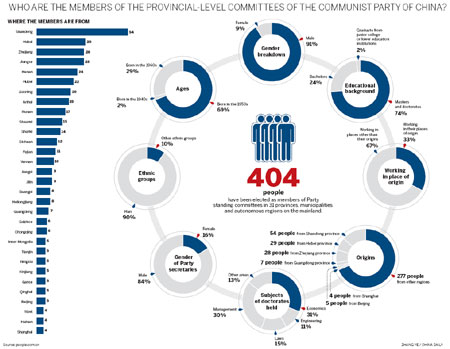
Members from the political center Beijing only occupied five seats. Those from economic powerhouse Guangdong province took seven seats, and Shanghai natives got four seats.
Members of the provincial-level standing committees of the Party are elected every five years. The 18th National Congress of the Communist Party of China, which is scheduled for the second half of this year, will follow the local congresses.
One scholar attributed the popularity of Shandong natives to Confucianism.
"Shandong officials seem to be followers of traditions and Confucius philosophy," said Shandong scholar Yan Shengdong.
Yan, an assistant professor at the Qilu Culture Research Center of Shandong Normal University, said natives of the province value political careers and practice the tradition of "building morals, building contributions and building opinions".
But Mao Shoulong, a professor in governance at Renmin University of China, said people from the populous province spread across the country during wars over the last century, and that may explain the Shandong majority.
"Moreover, most cities of the province have achieved strong development, and therefore the career development of city officials has hit a fast track."
Mao said Beijing, Shanghai and Guangdong have long been destination areas for immigrants, which is why so few members of the committees are from the political and economic centers.
Though many officials were born in the regions, they registered as officials originating from other parts of the country, he said. And many from the regions, especially Guangdong, are more interested in business than politics.
On the list of the committees, 29 officials, or 7.1 percent, are from Hebei province and 28 are from Zhejiang province.
"Zhejiang officials have made great contributions to the province's economic boom, and Hebei officials are experts in interpersonal skills," Mao said.
The reshuffle of local Party leadership has also brought younger and better-educated officials onboard.
Among the new lineup, 118 people, or 29 percent, were born after 1960.
The standing committees of the Xinjiang Uygur and Tibet autonomous regions have the largest number of leaders born since 1960, with seven each. Normally, a provincial standing committee only has 12 or 13 leaders.
Wang Yukai, a professor with the Chinese Academy of Governance, said the difficulties and challenges that younger officials face in ethnic regions can improve their decision-making ability.
Liang Yanhui, a professor at the Party School of the Central Committee of CPC, said the rising number of leaders born after 1960 will mean an increase in innovative ideas.
People with master's degrees or doctorates took up 74 percent of the seats and officials holding bachelor's degrees took 24 percent.
Sun Zhengcai, 49, Party secretary of Jilin province, once worked as a researcher at Beijing Academy of Agriculture and Forestry Sciences, and was chief editor of the book Research on Corn Growing in 50 Years.
Zhu Lijia, a public management expert at the Chinese Academy of Governance, said it's not a surprise to see such a high number of officials with strong academic backgrounds, as that has been a trend in recent years.
Women took 9 percent of the positions in the Party committees.
Officials of ethnic groups got 10 percent of the seats. Ethnic groups account for about 8.5 percent of China's population.
Contact the writer at wanghuazhong@chinadaily.com.cn


Copyright 1995 - . All rights reserved. The content (including but not limited to text, photo, multimedia information, etc) published in this site belongs to China Daily Information Co (CDIC). Without written authorization from CDIC, such content shall not be republished or used in any form. Note: Browsers with 1024*768 or higher resolution are suggested for this site.
License for publishing multimedia online 0108263 Registration Number: 130349