A revised 24 Filial Exemplars stipulates how to love and care for parents and is aimed at a new generation, Wang Ru reports.
|
 |
|
Li Min/China Daily |
Zheng Yuanjie, also known as the "King of Fairy Tales", has more than 3.4 million fans on the micro-blogging service Sina Weibo, where he often expresses his views on social and personal issues, including filial piety to his parents.
He has posted pictures of himself washing his mother's feet, and cooking for his parents, who are both over 80 years old.
His highly publicized filial love has won him support and compliments, while others express their shame that they do not treat their parents like Zheng.
However, when the Office of the National Committee for Senior Citizen Affairs recently published 24 Filial Exemplars, guidelines targeted at a new generation, it stirred up a mix of emotions.
According to the guidelines, children should visit their parents often, call them at least once a week, teach them to use the Internet, buy insurance for them and watch films with them.
Some of the guidelines are seen as novel in relatively conservative Chinese culture, like telling your parents how much you love them and supporting single parents to remarry.
"The intention is good, but there is no absolute standard of filial piety. The whole of society and government should do more, practically, to benefit the elderly and cope with an aging society, rather than just release some guidelines," says the writer Xiao Fuxing in Beijing News.
Zhu Yuan, a senior writer at China Daily, is more positive: "People should bear in mind that the new code of conduct is not a law that people have to abide by. The code of conduct is simply meant to remind children that their parents need their care and attention."
Naturally, there are also divergent opinions on the Internet.
"I don't even have time to cook for myself. How can I cook for my parents?" says one post on Sina Weibo.
"The government shouldn't divert the public's attention. The elderly need a better welfare system, not only children's filial piety," another comment adds.
Filial piety has traditionally been a core moral standard in Chinese thinking. "Among the hundred virtues, filial piety comes first" is one oft-repeated saying.
But the situation has changed since the ancient 24 filial stories came to prominence, as children are more mobile and the situation is more complex than simply showing filial piety by kneeling down or performing sacrifices.
It has been 10 years since Li Feng, 32, left his hometown in Shanxi province. Like millions of migrants to the big cities, he worked in Shanghai, Guangzhou and finally settled down in Beijing three years ago.
His parents, both in their 60s, retired several years ago and often pressure their son to find a girlfriend and get married.
"For me, the guidelines are a good reminder. Though my parents ask me for nothing, I suddenly realized I owe them," Li says.
Liu Lianfeng, 37, an accountant, works in a State-owned enterprise and lives in Beijing with her husband and their 5-year-old son. In 2011, she picked up her parents from her hometown of Dalian, in Liaoning province, to bring them to Beijing.
"My parents raised me in a poor village. I want to make it up to them," says Liu, who bought an apartment costing 1.5 million yuan ($235,900) for her parents.
"But I was busy at work and looking after my son. So, though we lived nearby, I didn't have much time to spend with them and didn't quite realize they couldn't get used to life in Beijing until I found their health condition was declining."
"I think old people like my parents who can't follow changes in society, need love and care from their children more than anything else."
Kou Zhenjie, 54, retired three years ago. She moved to Beijing to look after her newborn grandson for her 29-year-old daughter, who works at a foreign company.
"My biggest happiness derives from my daughter and my grandson, as long as they are healthy and happy," says Kou, who nevertheless admits she feels lonely sometimes and misses her former colleagues and neighbors in her hometown.
"My daughter is so busy and stressed out, what else can I ask from her? She can't follow the guidelines of filial piety, but it doesn't mean she is unfilial," Kou says.
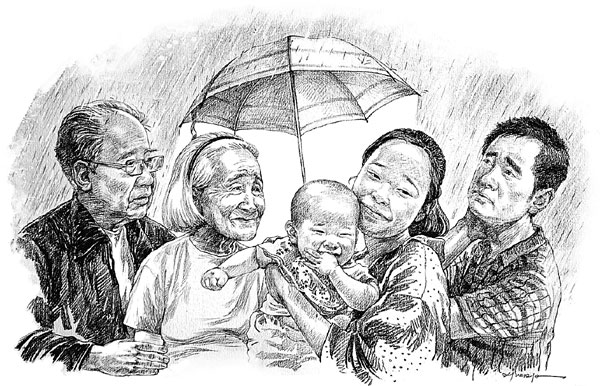
"Filial piety should have two forms. One is the cultural and moral sense that children should show their filial respect; the other is economic responsibility, which is not only the responsibility of children but the whole welfare system," says Tang Jun, a social policy researcher with the Chinese Academy of Social Sciences.
By 2011, China had 167 million people over 60, or 12.5 percent of its population. The UN's definition of an aging society is 10 percent.
By 2020, the elderly population will reach 243 million and this aging will speed up until 2030, when the country will become the world's most aged.
Meanwhile, due to the predominance of single child families, children born in the 1980s will need to feed and look after their parents.
"China is facing a problem of nursing and feeding its aging population," says Mu Guangzong, a professor at the Institute of Population Research, Peking University.
Chen Wenhui, assistant chairman of the China Insurance Regulatory Commission, the country's insurance regulator, admits there is a huge shortage of retirement funds at a meeting in July.
"It has become a burden for families and society. Unless our government and the whole of society works together to cope with the challenge, China's elderly will hardly have a secure future."
Contact the writer at wangru@chinadaily.com.cn.


Copyright 1995 - . All rights reserved. The content (including but not limited to text, photo, multimedia information, etc) published in this site belongs to China Daily Information Co (CDIC). Without written authorization from CDIC, such content shall not be republished or used in any form. Note: Browsers with 1024*768 or higher resolution are suggested for this site.
License for publishing multimedia online 0108263 Registration Number: 130349