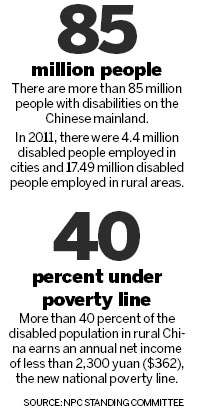
More than 40 percent of disabled residents of rural areas will be deemed poor under the revised poverty threshold the central government announced in November, according to an evaluation report released by the top legislature on Monday.
That means that of the 62 million rural disabled Chinese, according to a 2006 nationwide survey on disability, 24.8 million are mired in poverty.
Under the revised definition of poverty for the rural population, a rural resident whose annual net income is less than 2,300 yuan ($362) is impoverished.
 |
|
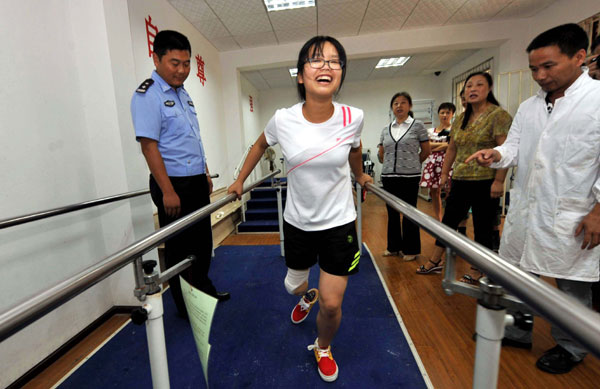
Xie Renci, a 16-year-old who lost her right leg 12 years ago, tries an artificial limb in a rehabilitation center in Guiyang, capital of Southwest China's Guizhou province, on Aug 7. [Photo/Xinhua] |
About 12.7 percent of the rural population, or 122 million rural residents, are now targeted for the government's poverty aid network, according to the State Council's Poverty Alleviation Leading Group Office.
From May to June, a law enforcement team under the National People's Congress Standing Committee probed the implementation of the law on protecting the disabled enacted in 1990 and amended in 2008.
Li Jianguo, vice-chairman and secretary-general of the NPC Standing Committee, said there are more than 85 million people with disabilities on the Chinese mainland.
The average income of families with disabled members is about 60 percent of the national level, he added.
Bo Shaoye, head of the rights protection department of the China Disabled Persons' Federation, said poverty among the disabled is related to multiple factors.
"Impoverished disabled people require more attention, not just because there are so many, but also because of the barriers they face, such as fewer opportunities for education, employment and skill training compared with the general population," Bo said.
The inaccessibility of living subsidies among the disabled in rural China topped the issues of concern in the 17,000 petitioning letters and complaint calls the federation handled in 2011, he said.
The government should enable people with disabilities who can work to get jobs and set up special funds to subsidize those who cannot because of their disabilities, Bo said.
Xu Mei, who uses a wheelchair and works for a local disabled persons' federation in the Gaoxin district of Hefei, Anhui province, urged the government to provide more living subsidies for disabled people and to make the application process more transparent.
Xu said there are 400 disabled residents in the district she works for, but less than 5 percent of them are eligible for minimum subsistence allowances.
"The requirements for receiving those subsidies are too rigorous, and local officials usually determine who is eligible for the subsidies by their guanxi (social connections) rather than economic plight," Xu said.
The NPC's Li Jianguo also said that the employment rate of the disabled is low.
"Many employers do not provide jobs for people with disabilities, which the law requires, even though they have positions suitable for them," he said.
The law on protection of disabled persons stipulates that the government and society should help people with disabilities recover or offer tools to help them regain some functions.
However, results from nine provinces, municipalities and regions showed that a large number of cities and counties don't have sufficient facilities, resources and professionals to help people with disabilities, Li said.
In one province, only 1 percent of people with severe mental disabilities received basic medicine for free, the NPC Standing Committee's law enforcement team found during an inspection tour, he added.
Regarding education, only about 71 percent of disabled children have access to the nine-year compulsory education, compared with the national level of 99 percent.
Li urged that the government should ensure that its financial investment to promote the development of people with disabilities should grow in pace with economic development.
Guo Bin, who works for Shenzhen-based Equity and Justice Initiative, an NGO dedicated to fighting discrimination against people with diseases such as HIV/AIDS and disabilities, believed that the legislators should work harder to improve the judicial interpretation for the law on protecting the disabled to make it more feasible.
Contact the writer at hedan@chinadaily.com.cn


Copyright 1995 - . All rights reserved. The content (including but not limited to text, photo, multimedia information, etc) published in this site belongs to China Daily Information Co (CDIC). Without written authorization from CDIC, such content shall not be republished or used in any form. Note: Browsers with 1024*768 or higher resolution are suggested for this site.
License for publishing multimedia online 0108263 Registration Number: 130349