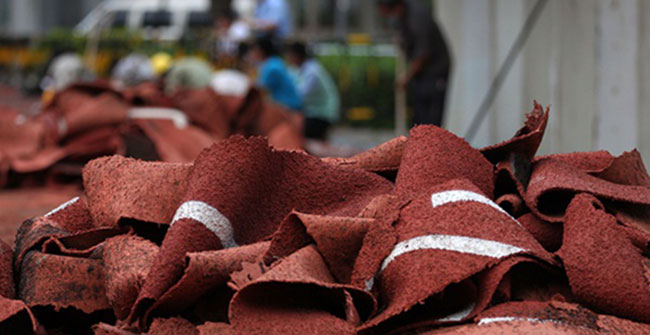
These slim and flat fields look like an abandoned riverbed, between two hillsides in Mudu town in the southwestern outskirts of Suzhou, Jiangsu province. Farmers laboring here have taken it for granted for generations. However, when an archaeological team took a look in 2009, this landscape was found to be the debris of an ancient city moat. An investigation unveiled an underground city with more than 2,400 years' history.
The team, co-organized by the Chinese Academy of Social Sciences and the Suzhou Archaeological Institute, has recently finished the first stage of study. Based on that survey, the expanse of relics ranges 6,728 meters from north to south and 6,820 meters from east to west, covering an area of 24.79 sq km.
It is probably the biggest find of ancient city relics from the Spring and Autumn Period (770-476 BC) ever known in China, according to Chen Jun, director of Suzhou Archaeological Institute, though he adds it is still early for a final conclusion.
"It is extremely rare to see such complete relics of a Spring and Autumn city in this highly developed area of southern Jiangsu province," Chen says.
The experts have found about 240 sites of many types, including tombs, workshops and city gates in water. Excited academics hope the findings will help to solve some historical puzzles.
Wu and Yue were two powerful vassal states that feuded in the Yangtze River Delta during the Spring and Autumn Period and early Warring State Period (475-221 BC). Their cultures had a large influence on modern-day Jiangsu and Zhejiang provinces, and some of their historical legends are household stories for Chinese people. However, continuous fighting between the two provoked massive sabotage on tombs and destroyed many cultural relics during their time.
Zhejiang established an institute on the two states' history as early as the 1930s, but its study focused on the historical files due to a lack of important archaeological findings. A large-scale jade article depot was found near Suzhou in 1986, followed by the discovery of some high-level tombs and ancient village relics. The whereabouts of Wu's capital, the center of this cultural cluster, becomes a common question for archaeologists.
According to numerous historical references including Shiji, or Records of the Grand Historian, Wu's capital was located around Suzhou during the state's final years. Historians have long speculated it was buried under Suzhou's downtown, but the discovery of an ancient city at Mudu has stirred a new idea. The city excavation was thus listed on the country's 10 biggest archaeological findings in 2011.
"We found their tiles and some delicately designed wooden construction components, for the first time around the Yangtze Delta," says Tang Jinqiong, an archaeologist on the panel from CASS, who explains tiles excavated in the Yangtze River Delta are usually no more recent than the Han Dynasty (206 BC-AD 220).
Tang adds that some sections of city walls were piled up, which is uncommon among contemporaneous constructions that usually used a ramming method. Some other unique building styles also have been detected on the walls.
"It's not exaggerating to suppose this is the highest-level city of a state at that time. Nevertheless, we so far can only say it is a relic of the late Spring and Autumn Period that has the obvious characteristics and size of a capital city. We need further proof to say whether it is the Wu capital."
In recent years, several other sites in southern Jiangsu province were suspected to be that capital, but the evidence was thin.
"The discovery of the Mudu ancient city has established a home for all the tombs and cultural relics surrounding Suzhou," says Song Jian, chief of archaeological division of Shanghai Museum. "The evidence bring legend into reality. The general public will thus have the chance to know a more vivid history of Wu and Yue."
Chen says his Suzhou Archaeological Institute plans to publish a popular book based on the findings. A historical park has also been conceived to better inform the public, but the plan is still under wraps to avoid any possible harm brought by swarming visitors.
Chen says the next steps in the excavation will begin in 2013, which will try to define the outline of the ancient city and the connection between the city and surrounding cultural relics.
"Archaeologists have concentrated so much energy on exploring the value of ancient tombs in this area," he says, suggesting the Mudu discovery may change the approach of future studies.
"But this is an important trial, processing the interdisciplinary study on a cultural cluster as a whole," Chen says. "The job will take a long time."
Zhou Furong contributed to this story.



Copyright 1995 - . All rights reserved. The content (including but not limited to text, photo, multimedia information, etc) published in this site belongs to China Daily Information Co (CDIC). Without written authorization from CDIC, such content shall not be republished or used in any form. Note: Browsers with 1024*768 or higher resolution are suggested for this site.
License for publishing multimedia online 0108263 Registration Number: 130349