Comments()
  Print
Print  Mail
Mail  Large Medium Small
Editor's note: In 2012, China's economy encountered more difficulties than it would in a normal year. Some difficulties are, so to speak, imported - like the sluggish demand from its major trade partners while they were trying, with difficulty, to solve the problems brought by the financial crisis of four years ago.
Other difficulties stem from precautions the country has taken to prevent wider trouble - controlling inflation, repressing surging prices in the real estate market, and slowing resource-and energy-intensive industries. The main purpose of these efforts is to make the economy less dependent on exports and inexpensive labor, and more on quality production and domestic consumption.
A new phase of this endeavor began as the new national leadership, headed by Xi Jinping, emerged from Beijing's power transition in November. At the Central Economic Work Conference last week, policy makers decided to muster "greater courage and wisdom" to take the nation's reform and development forward.
Society's initial response to the renewed commitment to reform was clear. The Shanghai stock market saw its strongest rally in two years. But how do economists assess China's opportunities in 2013 after studying the Central Economic Work Conference communique? What changes are they looking forward to? And what dangers do they think China should watch out for? We invited five of them to share their views.
|
 |
|
 |
A1
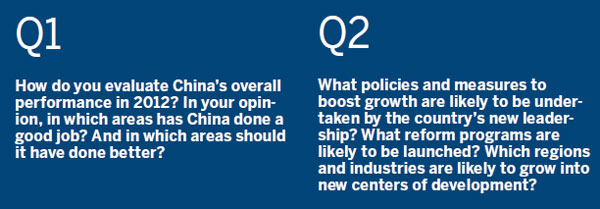
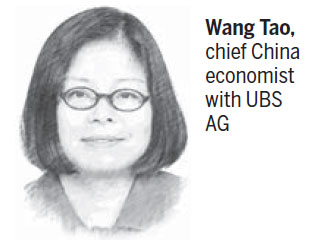
The economy slowed for two main reasons: The global economy was weak, and this hit Chinese exports. The other reason was due to property-tightening measures and credit controls which led to a slowdown in property and infrastructure investment starting in late 2011. The government changed its policy direction in the spring, easing credit conditions and reversing infrastructure spending, which has led to a moderate recovery in recent months.
Corporations reduced their inventories throughout much of 2012, and excess capacity became a concern as demand weakened. Corporate profits dropped sharply. But there is less of a push now to reduce inventories, and industrial profits are increasing again in the fourth quarter.
|
 |
A2
The new leadership has set the tone for next year: They will continue proactive fiscal and prudent monetary policies. The new leadership is concentrating on urbanization being the big driver of domestic demand, which should attract more investment on public infrastructure. But it's unclear how they will stimulate consumption.
We expect the leadership to push forward in 2013 with measures that have already won wide support. These may include reforms to energy prices and resource taxes, as well as developing the bond market and expanding pension and health insurance. I think various services, particularly healthcare and public services, should be developed more rapidly.
A3
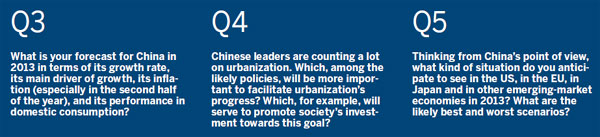
We expect GDP growth to recover from 7.6 percent this year to 8 percent in 2013. I'm not sure how much change we will see to the country's growth model. That will only happen slowly. We think consumer price index inflation will rise in 2013, mainly as a result of rising food prices. We think CPI will average 3.5 percent. Non-food inflation may rise because of reforms to utility and energy prices.
A4
The most important reform should be increasing public spending on services so that migrants can have better access to schools and healthcare, and can have better healthcare insurance, pensions and other benefits associated with a social safety net. This will involve tax and public finance reforms, and will be difficult. I think true urbanization will stimulate investment as well as consumption.
A5
We expect the US economy to maintain a modest growth rate (2.3 percent), Europe to stagnate and Japan to grow very little. Emerging markets may recover somewhat from 2012 as their exports become more stable and they no longer have to worry about inflation when setting their monetary policies. For China, this means the rate of increase for exports will become stable at about 8 percent.
In the best case, the US will show strong growth if it avoids the fiscal cliff. And the crisis in the eurozone will be resolved. In the worst case, the US will go over the fiscal cliff, driving down the country's growth. Or the eurozone crisis will worsen.

 Learning new skills of old craft
 Drill helps school prepare for potential attacks
 Last tomb standing in construction site relocated
 Shangri-La's Care for Panda project takes root in Sichuan
 Snapshots of Chinese cities in 2012
 Confucius Institute Conference held in Beijing
 China starts deep Antarctic expedition
 Booming yachting industry attracts top clubs
Copyright 1995 - 2010 . All rights reserved. The content (including but not limited to text, photo, multimedia information, etc) published in this site belongs to China Daily Information Co (CDIC). Without written authorization from CDIC, such content shall not be republished or used in any form. Note: Browsers with 1024*768 or higher resolution are suggested for this site.
License for publishing multimedia online 0108263 Registration Number: 20100000002731