Comments
  Print
Print  Mail
Mail  Large Medium Small
The nation's master watch and clock makers have emerged from a difficult decade to make the most of the luxury market. Wang Kaihao reports in Tianjin.
Staring at the microscope and testing tiny details - Yang Zuobin, 63, devotes his mind to the miniature world of mechanical watch movements.
Yang has been at Sea-Gull Watch Group for 42 years. The factory is in Tianjin, the birthplace of China's first watch in 1955.
|
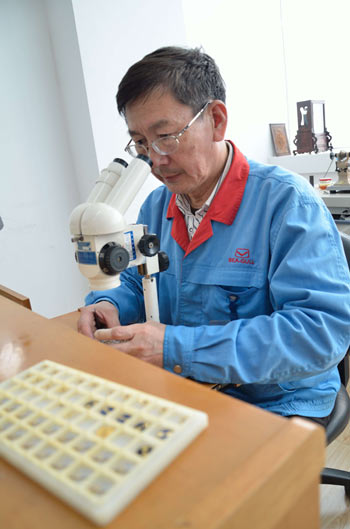 Yang Zuobin adjusts watch movements in Sea-Gull's workshop.Provided to China Daily |
He was honored as one of 12 "Chinese Watch and Clock Masters" selected by the Chinese Horologe Association in June, and has the title "chief technician" at work.
"I am only a worker, not an engineer," he says, humbly. "I didn't make them, but assembled them."
In 2011, he assembled the first watch on the Chinese mainland that combines three major symbols of a high-end mechanical watch: tourbillon, minute repeater and calendar.
An anonymous businessman from Xiamen, Fujian province, bought it for 1.28 million yuan ($201,000), the most expensive domestic watch ever sold. It is a complex and small machine containing 435 components.
"Putting these components together takes days, but I have to spend months adjusting the movements and erasing errors."
Yang began assembling watch movements in 2004, when he was supposed to retire.
He had planned to open a repair store in a supermarket after retirement, but his stall was cancelled right before he moved in.
"When I was at a loss thinking about what I would do in the future, the managers asked me to return to the factory and assemble watch movements."
Sea-Gull began producing its high-end movements in 2002. However, it lacked skillful assemblers.
"Even the tourbillon is not that puzzling," Yang says, referring to one of the most complicated elements in luxury watches. "Though I had never seen it before, I soon understand its structure."
"Maybe that's because I've been dealing with machines for a long time. No matter how complex a watch is, it is a machine."
He entered the factory in 1970 after studying machinery for five years in a technical school, and worked for eight years on a lathe, until he transferred to be a machine repairer for 15 years.
"I try to love whatever I do. I have strong vanity because I always want to be top at whatever work I do."
Yang accidentally came into possession of a textbook on how to repair watches from an abandoned library during the "cultural revolution" (1966-76).
He began to tinker with watches in his spare time for relatives.
He is proud of experiencing the golden age of Chinese watches in the early 1980s, though he faced a bleak future when the factory and watch industry as a whole was hit by quartz watches. The factory authorities announced on Chinese New Year of 1992 that workers would be temporarily laid off.
"I was not in the mood to celebrate New Year and I immediately decided to have a secondary occupation to make ends meet," Yang says.
On that year's Lantern Festival, he brought some watch-repair tools and rode a bicycle on the street while his family members went to see their relatives.
"I stopped half an hour later and found myself in the countryside," he recalls. "I went to the nearest village. The village head was very happy and used the loudspeaker to gather all the villagers and bring their broken watches."
That was his first repair job, for which he earned 22 yuan - his salary was no more than 200 yuan - and ended up fixing all the villagers' watches that week. He went on to eight neighboring villages for two months until factory manufacturing resumed and he became a mold repairer.
However, his enthusiasm for watch repairs was not to be extinguished. He went to a canteen at Tianjin University near the factory every noon to fix watches for the students, and continued going to the countryside on weekends.
"I hope those students remember me," he giggles. "The watches accompanied them through their final exams."
His part-time campus repair shop lasted for a decade, until the canteen was demolished in 2001. He says those years of viewing all kinds of watches helps his work today.
He moved to the after sales department in the factory to fix watches in the last few years before his "retirement" in 2004.
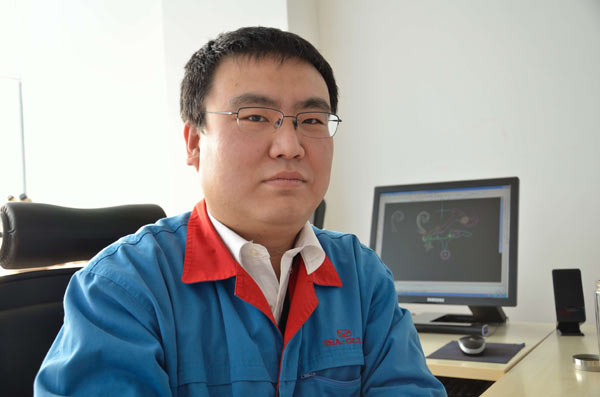
When he worries about the future of watch making, his work colleague Zhao Guowang, 34, who designed the blueprint of the 1.28-milliom-yuan watch, offers hope.
 |
|
Zhao Guowang is a young master and the big hope of China's watch industry. Provided to China Daily |
"When you review masterpieces throughout history and learn the theory by heart, it is natural to create something new," Zhao says, the youngest "master" among the 12 award-winners while the others are generally in their 60s or 70s.
Zhao had ankylosing spondylitis, a chronic disease of the spine, at the age of 6. Though he says it is not that painful anymore, his movements when he walks are affected.
He suffered from severe complications of the disease for one year in college, when his weight fell to 45 kg.
"I felt close to death and this changed my attitude to life. I always try to find the positive side of whatever I face. I felt lucky to finish college and was not that picky when it came to job-hunting."
He joined the factory in 2001. Because of his disease he cannot do most outdoor activities, but he does have a lot of patience and showed a talent for design.
"We honor the masters because we encourage the others to learn technique," Lu Jun, Sea-Gull's general manager, said at the award ceremony in June. "It would hardly be possible for the industry to progress without their efforts."
"Young people are more ambitious and creative," Yang says. "But perhaps they need to be ready to settle their hearts to absorb the skills."
"It is true especially for the young men who tend to frequently change jobs," Zhao agrees. "You can see there are many more women than men in the factory."
Contact the writer at wangkaihao@chinadaily.com.cn.

 Tornadoes destroy 500 homes in E China
 Fire in S China takes down food warehouses
 Hospital ship Peace Ark stops in Maldives
 Underwater kissing contest a wet affair
 China's youngest city glistens under palm trees
 Xinjiang tourism recovering
 Mourn for students in San Francisco air crash
 Double-decker bus caught fire in Shanghai
Copyright 1995 - . All rights reserved. The content (including but not limited to text, photo, multimedia information, etc) published in this site belongs to China Daily Information Co (CDIC). Without written authorization from CDIC, such content shall not be republished or used in any form. Note: Browsers with 1024*768 or higher resolution are suggested for this site.
License for publishing multimedia online 0108263 Registration Number: 20100000002731