AIDS patients get help in Anhui
 |
|
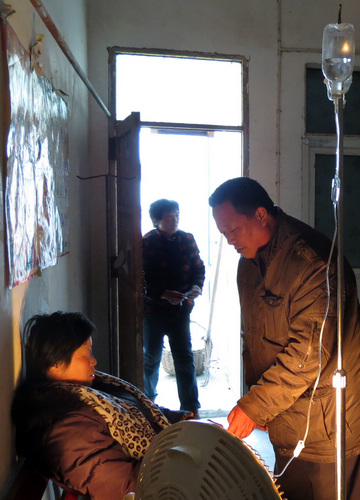
Zhang Zhenjiang, a doctor in Lixin county, Anhui province, takes care of an AIDS patient. [WANG XIAODONG / CHINA DAILY] |
"Relax; it takes time for the drug to take effect," Zhang Zhenjiang gently reassured a patient as he took her pulse. "Trust me. You'll be OK."
The woman, who was lying on a long wooden chair receiving an infusion at the doctor's home, was one of dozens of AIDS patients Zhang has cared for over the past 17 years in Lixin county, Anhui province.
"I usually treat patients at my house, because taking care of them at the village clinic would put some off," the 58-year-old said.
Although medical advances have lessened fear of the deadly virus, discrimination against HIV and AIDS patients has not been entirely eliminated in his native Liuran village.
Zhang's career started in 1995, when HIV was detected in his and many nearby villages. Several years before, what was thought to be a mysterious disease had been found in many residents.
Zhang said many people started to "become thinner every day, and parts of their bodies became infected and would not recover after repeated treatment".
No one knew what the disease was until authorities announced the discovery of HIV years later and started to treat patients, he said.
"The news caused panic," Zhang recalled. "We didn't know what to do. I remember three people died on the same day in a neighboring village."
The HIV epidemic was caused by poor villagers in Lixin selling their blood in the early 1990s, according to the county's center for disease control and prevention.
The center later screened more than 200,000 people and found more than 1,000 had HIV.
Fearing infection, no village doctor would dare treat patients — except Zhang. "I decided to try. I saw these patients dying every day and no one treating them," he said, although he admitted that taking care of HIV and AIDS patients is not easy and requires great courage. "One of my earliest patients was paralyzed and large parts of his hips had festered. I was terrified and had to ask my wife to clean and sterilize the area before applying medicine on the wound."
Zhang gradually got used to the treatment, but like the patients, he has also suffered discrimination due to a lack of knowledge about the disease among villagers.
"What distressed me most was that, for several years, few people in my village would have any contact with me. Even my daughters refused to see me," he said. "But I just couldn't abandon these patients, because no one paid attention to them.
"I live with them in the village, and I know they became infected because their poverty led them to sell blood instead of turning to drugs or prostitution. They shouldn't have to live in shame."
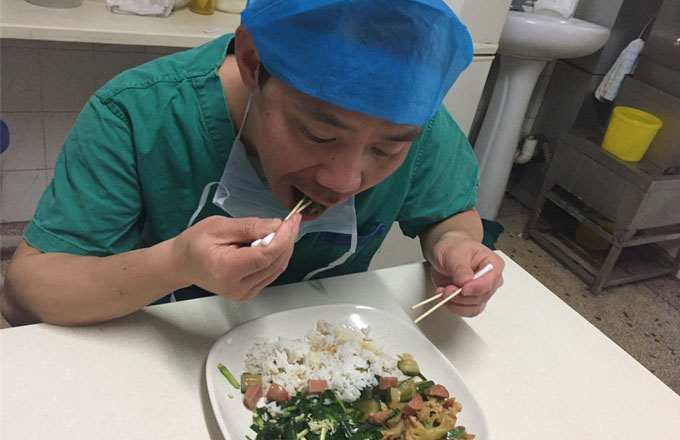
To ease the concerns of the villagers, he invited his patients to dinner to prove common physical contact would not transmit the disease.
The county government has made great efforts to prevent HIV and provide treatment and education through various channels, including television and radio. More than 500,000 pamphlets had been distributed to residents by the end of last year, authorities said.
HIV and AIDS patients are entitled to free anti-viral treatments and basic living allowances. Their children can receive free compulsory education.
The mortality rate of AIDS patients has been reduced to around 3 percent, from as high as 25 percent in 2002, the county's CDC said.
"As a village doctor, it's my duty to do my best to treat patients, including those with HIV," he said. "The government policies have also made my work much easier."
Due to Zhang's efforts, most of the first HIV and AIDS patients to be diagnosed have survived, including some who have lived with the virus for 20 years, he said.
Attitudes toward HIV and AIDS have also changed. "Most villagers don't fear patients and don't avoid them any more," the doctor said. "Patients are gradually being accepted."
Zhang said he plans to retire in a few years and has decided to send his son for training so he can take over his work.
"Doctors like Zhang are essential," said Lu Hongzhou, a public health expert at Fudan University's Huashan Hospital in Shanghai.
"A major obstacle to AIDS prevention and treatment at the grassroots level is a lack of qualified doctors, and we hope through our training programs they can better serve the people."
Lu will train Zhang's son for two months this year. The young man graduated from a medical school in 2008.
"I'm greatly relieved to see my son will receive good training and continue my job," Zhang said. "I hope all AIDS patients can receive proper treatment and can live like other patients, without facing discrimination."
Contact the writer at wangxiaodong@chinadaily.com.cn