Comments
  Print
Print  Mail
Mail  Large Medium Small
The parents of a teen vandal from Jiangsu province have apologized to the public for the graffiti their son scratched on a stone sculpture in an ancient temple in Egypt, which triggered an online uproar as Internet users dubbed it a "loss of face" for all Chinese people.
 |
|
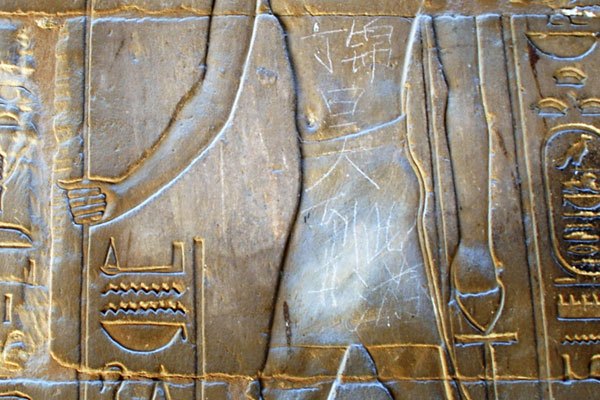
Graffiti on the defaced Egyptian artifact says "Ding Jinhao was here". provided to china daily |
A micro blogger found the Chinese characters carved on a cameo at the Luxor Temple, one of Egypt's most renowned archaeological sites, in early May. The characters say "Ding Jinhao was here".
The micro blog, posted on Friday night, triggered heated discussion online as the act of vandalism was condemned as being disrespectful to cultural relics.
Ding Jinhao's parents, who live in Nanjing, the capital of Jiangsu province, apologized for his behavior on Saturday and asked for forgiveness from the public after angry Internet users discovered and revealed the identity of the young man, aged 14, a middle school student in Nanjing.
"We want to apologize to the Egyptian people and to people who have paid attention to this case across China," Ding's mother said in Modern Express, a local newspaper.
Ding has realized the seriousness of his misconduct, according to his mother.
His father said they felt regretful after news about the case was spread online.
Shen, the micro blogger who posted the picture of vandalized relics, visited the Egyptian temple on May 6. "I felt embarrassed. It was my most unhappy moment in Egypt."
He said he hopes the case will remind Chinese tourists to behave while abroad and teach them the importance of protecting cultural relics.
The bad manners of some Chinese tourists, which include spitting and littering, have featured prominently in the media in recent years.
In March 2009, a retired man from Changzhou, Jiangsu province, carved his name on a rock in Taiwan's Yehliu Geopark, which triggered intense criticism.
In February, a tourist carved his name on a large cauldron in Beijing's Palace Museum. Failing to find the culprit, one of the museum's staff posted a picture of the vandalized cauldron online.
Chen Xu, a researcher from the China Tourism Academy, said the Tourism Law, which will take effect in October, will force some Chinese tourists to behave properly at tourist sites, but in the long run the key is to raise awareness of the importance of cultural relics and proper manners.
"Travel agencies and guides should also be responsible for preventing tourists from vandalizing cultural relics," he said.
Ye Qianrong, a professor of Chinese studies at Tokai University in Japan, said Chinese tourists' practice of writing their names at tourist sites could date back to the "cultural revolution" (1966-76), when many young students wrote their names in many places.
Ye, who hails from China, said the lack of education for good manners in schools and families is also to blame.
Copyright 1995 - 2010 . All rights reserved. The content (including but not limited to text, photo, multimedia information, etc) published in this site belongs to China Daily Information Co (CDIC). Without written authorization from CDIC, such content shall not be republished or used in any form. Note: Browsers with 1024*768 or higher resolution are suggested for this site.
License for publishing multimedia online 0108263 Registration Number: 20100000002731