

Changes 'will be in vain' if new policies are not implemented: official
 |
|
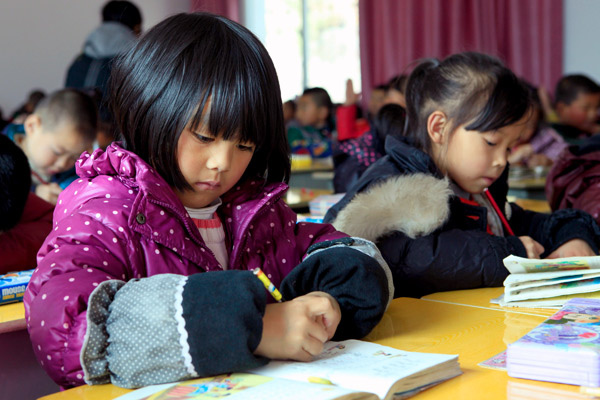
Students work on their assignments earlier this month during class at Changjiang Primary School in Badong, a county in Hubei province, where no homework is assigned to the students.[Liang Bin / for China Daily] |
Described as "a year of comprehensive reform for education" by Xu Mei, the Ministry of Education spokeswoman, 2013 saw a series of education reforms unveiled.
"I asked my son to learn English to take the exam, but he didn't get too much from those extra training classes but got enough to take the test," Chen said.
"Now I pay more attention to his language skills and hope that it will spark an interest. I don't have to push him to read Harry Potter after dinner. He likes it."
Chen's son won't be affected because he will take the gaokao in 2015, and the reform takes effect in 2016 in Beijing. However, she is one of many parents who since the reform was announced is beginning to think that listening and speaking skills are more important than the test itself.
The reform echoed the Communist Party of China Central Committee's Decision on Major Issues Concerning Comprehensively Deepening Reforms, released after its Third Plenary Session in November.
The decision made it clear that China will balance the allocation of resources in urban and rural areas.
According to the document, educational authorities were told to no longer classify schools as key or non-key institutions, which led to imbalanced resources. Key classes will no longer be allowed.
Concerning the college examination system, used to evaluate students over the past 30-plus years, China will consider a multi-evaluation system so schools do not just enroll students based on test performance.
"The education reform has stepped into a key period," said spokeswoman Xu.
"The problems facing education also concern many social aspects. The reform plan will be in vain if there is no real implementation. We hope all local education authorities and schools will take solid measurements to implement the reform plan.
"The ministry will pay more attention to supervision and push all local authorities to carry out the new policies to benefit the public"
As introduced by Liu Limin, vice-minister of education, the final reform plan will be released after collecting public opinion. The reform will be piloted in some provinces from 2014 and expanded in 2017. By 2020, a new testing and recruiting system will be formed and promoted nationwide, according to the plan.
Training organizations highlighted opportunities in the reform.
"We've talked to hundreds of students and parents of students about this change, and not a single one has indicated they will be less interested in speaking English because of this change," said Bill Fisher, CEO of Education First China, a company that specializes in language training.
"The simple reason is that our customers understand that learning English is a life skill that opens doors both personally and professionally, and the gaokao doesn't change that. In fact, the emphasis on exams and exam preparation has created a generation of students who do well in tests but cannot use English in the real world. This is a huge problem in China. The EF method focuses on building skills and confidence that will see test scores go up, but more importantly help students succeed in the real world."
Other organizations are making changes accordingly. "Although the changes made to the gaokao will make it uncomfortable for the students who are used to the traditional way of examination, we still have (at least) three years to adjust," said Wang Wei, vice-president of Xueersi, a training organization under the Tomorrow Advancing Life Education Group.
"With the release of more reform details, we will modify our classes accordingly. But there won't be big changes to our basic teaching concept."
More transparency
In late November, Cai Rongsheng, head of student admissions at Renmin University of China, one of China's most prestigious educational establishments, was detained and placed under investigation for allegedly selling university places.
Just weeks later, another high-profile figure, An Xiaoyu, vice-president of Sichuan University, the most respected college in southwestern China, was reported to be under investigation following allegations of corruption related to the construction of a new campus.
Early this month, the ministry released a regulation that urged local education authorities and universities to make admissions programs public. Admission rules, the results of autonomous exams, and the recruiting process must be readily available to the public. It will also unveil a master plan to reform college enrollment in the first half of next year.
Moreover, the ministry made public on its official website a hotline to report misconduct in the graduate school entrance exams, which will be held from Saturday to Monday.
Experts urged the authorities to give more rights to colleges and universities to establish more transparency.
"The reforms are only in the planning stage this year without any actual measurement," said Xiong Bingqi, vice-president of 21st Century Education Research Institute. "I hope more measurements will be carried out in the next year, especially promoting the reform of non-administration in higher education to establish modern universities."
Under the present system, university presidents are allocated specific levels in a political ranking system. University officials, from deans to the heads of student admissions, are ranked accordingly, which means a higher rank always translates into a louder voice in the decision-making process.
Chu Zhaohui, a senior researcher at the National Institute of Education Sciences, said: "The reforms on administration and the separation of enrollment from examination will have a major influence. I hope these measures will be implemented soon.''
Contact the writers at leilei@chinadaily.com.cn
|
|
|
|
|
|
|
|

Copyright 1995 - . All rights reserved. The content (including but not limited to text, photo, multimedia information, etc) published in this site belongs to China Daily Information Co (CDIC). Without written authorization from CDIC, such content shall not be republished or used in any form. Note: Browsers with 1024*768 or higher resolution are suggested for this site.
License for publishing multimedia online 0108263 Registration Number: 20100000002731 




















 Op Rana
 Berlin Fang
 Zhu Yuan
 Huang Xiangyang
 Chen Weihua
 Liu Shinan