Editor's note: Beijing's determination to innovate is helping to transform it into a major high-tech center. The capital offers a range of opportunities designed to unleash the creative genius of technology specialists and enable it to achieve its full potential. China Daily takes an in-depth look.
In August 1952, an astronomy exhibition in Beijing introduced China's ancient astronomy achievements and modern knowledge to the capital's residents. "Long live Chinese astronomy," Joseph Needham, the British scientist and historian, wrote in his congratulations to the event - the first recorded science popularization event in Beijing after the founding of the People's Republic of China.
Needham traveled across China from 1942 to 1946 to research science history. After returning to Europe, he finished the influential paper Science and Civilization in China.
|
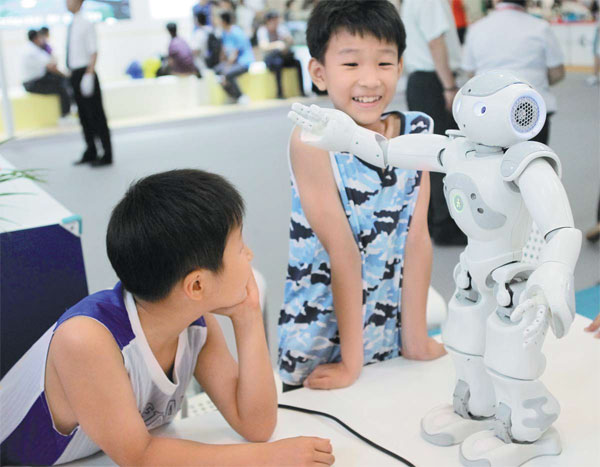
A dancing robot attracts the attention of two children at a science festival at Beijing Exhibition Center in July. More than 110 overseas and domestic organizations took part in the event, staged to increase the popularity of science. Zou Hong / China Daily |
Amazed by China's ancient scientific findings and great inventions, he raised "Needham's grand question", which is: Why was China overtaken by the West in science and technology despite China's earlier successes?
Sixty years later, Needham's question seems to belong only in the past, as Beijing has become an international scientific research technology innovation hub.
President Xi Jinping called for science popularization to be made as big a priority as innovation two years ago, when he attended a session in Beijing on National Science Popularization Day.
Beijing - with a population of 20 million and the home of China's leading universities and science institutes - is becoming a vibrant center of science popularization in China.
To more and more Beijingers, young and old, science and technology have become a part of their lives.
Last Saturday, a free public astronomy seminar about the power of dark matter in the universe attracted many young people to Beijing Planetarium. The program is one of dozens of the planetarium, which was founded in 1957.
In September, Beijing Science and Technology Festival, an annual science event organized by the Beijing Association for Science and Technology, will again gather national and international science lovers.
Last year, a weeklong festival in Beijing's Olympic Park attracted science educators from 14 countries who brought with them about 300 science projects to interact with local science enthusiasts, both parents and children.
Science projects that included the latest in 3-D printing, cloud computing and hands-on chemical experiments were no longer strange to the 100,000-plus visitors.
"We are confident of making the Beijing Science and Technology Festival one of the most successful science festivals worldwide, like the renowned Edinburgh International Science Festival," said Zhou Lijun, deputy director of the Beijing Association for Science and Technology, during last year's event.
Many types of science events reach out to the public and serve in different ways to ignite the public's passion for science and innovation.
A digital skills competition open to thousands of Beijing families has taken place in the city since 2004. Breaking the technology gap between generations and teaching more middle-aged and senior citizens to learn new technology such as the Internet is the clear theme of the program.
Meanwhile, since 2001, the Beijing Youth Robot Competition has continued to gain participation from almost all primary and secondary schools in Beijing.
Every two years, Beijing invited Nobel Prize laureates to attend forums and seminars that are open to the public. In 2013, the event had four Nobel Prize laureates, including US cosmologist George Smoot, who won the Nobel Prize in physics in 2006 for his work with the Cosmic Background Explorer satellite.
In June, Zhou was invited to attend the annual conference of European Science Event Association in Copenhagen and made a speech titled Popularizing science to 20 million people.
He said that the Chinese government will purchase more science popularization services for attracting companies and non-profitable organizations in the field.
"Science popularization has no border, and we like to share and learn experiences from other countries," Zhou said.
wangru@chinadaily.com.cn


Copyright 1995 - . All rights reserved. The content (including but not limited to text, photo, multimedia information, etc) published in this site belongs to China Daily Information Co (CDIC). Without written authorization from CDIC, such content shall not be republished or used in any form. Note: Browsers with 1024*768 or higher resolution are suggested for this site.
License for publishing multimedia online 0108263 Registration Number: 130349