ZHANG YAN
(China Daily) Updated: 2015-08-10 07:39
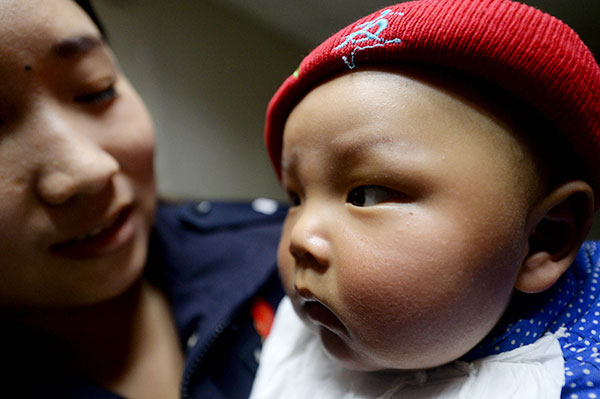
A policewoman attends to a boy in Xinxiang, Henan province, after he was rescued in March from a child trafficking gang. [Photo/China Daily]
Many say punishment would deter crime; others worry plan will endanger victims
Death penalty or not? That is a question facing judges who handle child-trafficking cases these days.
In June, calls on social media to hand down capital punishment to anyone involved in child trafficking triggered a heated debate on the appropriate punishment for such offenses.
As a deterrent
Among those voices, Chen Shiqu, director of the anti-human-trafficking office under the Criminal Investigation Department at the Ministry of Public Security, is well-known online as China's top official in charge of fighting human traffickers.
Chen wrote in a micro blog that defendants in "major child-trafficking cases should be sentenced to death to deter such crimes". He said judicial authorities have handed down relatively lenient punishment to child traffickers, resulting in rampant occurrences of such crimes.
"Appropriately using the death penalty on those who commit harmful crimes will effectively curb such crimes," he said.
Some Internet celebrities also joined those supporting the death penalty. Ren Zhiqiang, former chairman of real estate company Huayuan Property Co, also voiced his support to his tens of millions of followers.
"It's necessary to put child traffickers to death, considering the heavy destruction they cause to lots of families. Sentencing them to death will send a serious warning to others," he said.
"Law enforcement officers should also impose severe punishments to buyers of abducted children to reduce the strong demand," he said.
But others say that blaming courts' lenient verdicts may not be fair to the judges, who have to follow sentencing guidelines.
Xu Yongjun, senior judge from the criminal tribunal at the Supreme People's Court, said that judicial authorities issued a notice in 2013 that stipulated severe punishments for traffickers.
"Since then, we have been considering proper harsh sentences, including the death penalty, but it's impractical to put all of them to death," he said.
Under the Criminal Law, child abductors face a sentence of five to 10 years in prison. In particularly serious cases, such as abducting more than three children, causing death or serious injury, or selling a child or children overseas, the traffickers face prison terms of 10 years to the death penalty.
According to the high court, from 2010 to 2014, courts nationwide had passed sentence on 12,963 traffickers who had abducted women and children. More than half were sentenced to 10 or more years in prison or death.
Twenty-five traffickers in 16 cases have been sentenced to death since 2000, statistics from the high court showed.
Among them is Jiang Kai-zhi, who organized a 36-member gang in Yunnan that abducted and sold 223 children from late 2009 to August 2010. Another child trafficker given the death penalty was Ma Shouqing, who led a gang that trafficked 37 children from Yunnan province. Ma was executed in February. The high court approved the death sentence because of its serious consequences, including the death of a 2-year-old victim during transportation.
Limited effect
Not all law experts and lawyers agree that the death penalty is appropriate for all child traffickers.
Gu Yongzhong, deputy director of the Criminal Procedure Research Institute at the China University of Political Science and Law, argued that its effect would be limited.
"It doesn't mean that if we draft a special law to stipulate severe punishment, such as issuing death sentence, on traffickers, such crimes may dramatically decline," Gu said.
Some are worried that sentencing all human traffickers to death would remove the difference of penalties for two groups of traffickers-those who trafficked children but didn't harm them, and those who hurt and even killed victims.
Wang Jin, a graduate student majoring in criminal procedure laws at Renmin University of China, and a mother of a 2-year-old girl, said: "I personally hate child traffickers. But if the judicial authorities sentence them all to death, abducted children could fall into danger and the suspects may become so desperate that they seriously injury or even kill the children, which will make it harder for the police to arrest them."
The call for the death penalty on human traffickers also came at a time when China is reducing the number of crimes that are subject to capital punishment.
Zheng Kai, a Beijing criminal lawyer, said: "We can learn from other countries, where criminal offenses haven't risen although they abolished the death penalty. Abolishing the death penalty is a worldwide trend."
Poverty to blame
Gu, at China University of Political Science and Law, said the death penalty is not the fundamental solution for child trafficking.
Chen, with the Public Security Ministry, said poverty should be blamed for the sales of children in remote rural areas, such as the southwestern provinces of Yunnan and Guizhou, as well as the Guangxi Zhuang autonomous region.
He said the buyers also should be blamed. Childless couples in comparatively well-to-do provinces, including Guangdong, Fujian and Shandong, often buy or adopt abducted children because they still believe in the importance of "carrying on the family line" and "having sons to support them when they grow old", he said.
Due to a strong market desire, the suspects traffic the children to seek huge profits, he said.
Under a proposed amendment to the Criminal Law, which was submitted in June to the National People's Congress for approval, buyers of trafficked infants would be held criminally accountable.
Currently, if buyers don't physically abuse the children or hamper police rescue efforts, they won't face criminal punishments.
"When the amended Criminal Law takes effect, it will eliminate the demand from buyers, and attack the trade in human traffic at its very roots," said Dai Peng, director of the Criminal Investigation College at the People's Public Security University of China.


Copyright 1995 - . All rights reserved. The content (including but not limited to text, photo, multimedia information, etc) published in this site belongs to China Daily Information Co (CDIC). Without written authorization from CDIC, such content shall not be republished or used in any form. Note: Browsers with 1024*768 or higher resolution are suggested for this site.
License for publishing multimedia online 0108263 Registration Number: 130349