 |
|
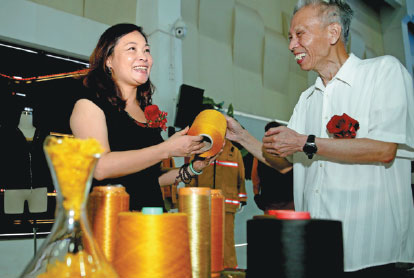
Ding Mengxian (right), researcher at the Changchun Institute of Applied Chemistry, recommends a high-tech fiber to fashion designer Deng Zhaoping. Made of a special military material that was only used in areas such as supersonic aircraft and aerospace, the fiber will play a significant role in the development of China's textile industry. Chen Jianli / Xinhua |
"President Xi Jinping supports the integration. He says it's a national strategy with great influence on the country's economic development and national security," Jiang said. "We will definitely promote further integration in the future."
China has also been cooperating with other countries to promote the program.
Volodymyr Korzhyk, a member of the Ukranian Academy of Sciences who has worked with Chinese scientists on military-to-civilian projects, said technology and materials developed for building battleships have been used in the production of nonmilitary vessels and high-speed railways.
"We've been working with China for more than 20 years and have a lot of experience at adapting military technology for civilian use," he said.
Jacques S. Gansler, a former US undersecretary of defense, said both sides are likely to benefit from the integration of military and commercial operations. Because of the higher production volume of "dual use" products, integration will produce cheaper goods and services for both commercial and military uses, Gansler said in a speech in Mianyang in October.
Although commercial businesses usually deal in short-term, low-risk investments, the military sector is able to make long-term, high-risk investments in innovative technology. Under an integrated system, companies in the civilian sector will be allowed to take advantage of the huge sums invested in military research and development, but equally the military sector will also be able to take advantage of the even-larger sums that private companies invest in research and development.
"We can see that China is pushing integration faster than any other country," Gansler added.
However, some experts are not so sanguine about the program's prospects and have sounded a note of caution.
Du Xiangwan, a senior adviser at the Chinese Academy of Engineering Physics, said some inventions produced by State-owned contractors may take years, or even decades, to become established in the civilian market, but that doesn't render the integration project worthless. Despite their genesis, many military-inspired innovations are perfect for use during peacetime.
"As warfare has become increasingly dependent on technology, a whole range of technologies has also become essential, and many of them have civilian applications," he said. "Although the transfer process may not be smooth, it's certainly worth attempting."
Zhang Jun, a manager at Sichuan Changhong Electric Co, a consumer electronics company in Mianyang that started out making military radars in the 1950s but has grown to become China's second-largest manufacturer of televisions, said integration may turn out to be a long and difficult process.
"The military-backed enterprises are used to working in a planned economy, so they lack extensive knowledge of life in competitive markets," Zhang said. "They are not entirely comfortable when faced with competition, and there have been a number of communications problems and misunderstandings.
"For optimum efficiency, we start to work at 1 pm, but are often unable to contact our partners from the State-owned enterprises because they don't start work until 2 pm," he said. "We operate different systems, and have been unable to reach agreement even over a small issue like this. That means some attitudes and systems will need to change for integration to be successful."
Contact the writer at pengyining@chinadaily.com.cn


Copyright 1995 - . All rights reserved. The content (including but not limited to text, photo, multimedia information, etc) published in this site belongs to China Daily Information Co (CDIC). Without written authorization from CDIC, such content shall not be republished or used in any form. Note: Browsers with 1024*768 or higher resolution are suggested for this site.
License for publishing multimedia online 0108263 Registration Number: 130349