 |
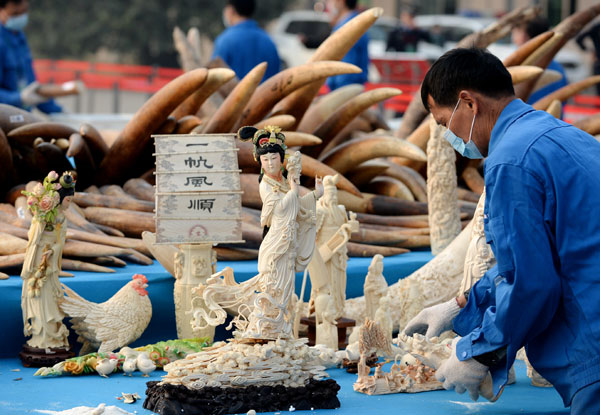
| Officers from the State Forestry Administration and the General Administration of Customs destroy 6.1 tons of illegal ivory items in Dongguan, Guangdong province, in January last year. It was the first time China destroyed confiscated elephant ivory. Li Xin / Xinhua |
China will continue its efforts to protect African elephants and curb the illegal ivory trade by cracking down on the black market.
"Combating the ivory trade and wildlife smuggling has always been a core task for China's law enforcement agencies," said Liu Dongsheng, deputy director of the State Forestry Administration, China's wildlife watchdog. And they are making a difference, he said.
"The number of illegal wildlife smuggling cases in 2014 dropped 70 percent from 2013," Liu said. Next, he said, "China will get tougher toward illicit tusks."
At the same time, China has strengthened its supervision of Internet channels that are providing a fast, covert means of covering up illegal transactions.
According to the International Fund for Animal Welfare, at least 18,590 animal-related items were for sale online in the country at the beginning of last year. Nearly 79 percent involved ivory.
The Forestry Administration has guided e-commerce platforms and logistics companies to cease providing the means for illegal trading in animal and plant products, including the means to advertise.
It also encouraged the public to decline, and also report, illegal ivory trade to the administration.
China has long been criticized as the world's biggest importer of ivory and blamed as being responsible for most African elephant poaching.
A report released by the nonprofit organization Save the Elephants and The Aspinall Foundation in December said skyrocketing demand for ivory in China has led to a smuggling boom that is driving the unsustainable killing of elephants.
The report also said the growing legitimate ivory trade in China is providing a smoke screen for illegal activity. It said "the system is presently out of control".
Meng Xianlin, executive director general of the Endangered Species Import and Export Management Office of China, said, "The truth is, the ivory market in China is shrinking, and China will gradually cut the number of licenses for retail outlets.
"The weight of authorized raw ivory in China every year is about 5 tons, but actually only 80 percent of that is made into ivory products," he said. "And the sales numbers are dropping. The investigation found that the sales of illegal ivory products is way smaller than the legal sales."
Meng also said consumption in China should not be blamed as being the major cause of the extinction of African elephants. Africa should step up to its own responsibility, he said.
John E. Scanlon, secretary-general of the Convention on International Trade in Endangered Species of Wild Fauna and Flora, agreed that it's not just China's responsibility. Other countries need to take responsibility for their own plants and animals and take measures to protect them, he said.
"We need support from source, transit and destination countries," Scanlon said. "China has been dealing with it responsibly as a destination country, showing great leadership through customs and other enforcement departments.
"Source and transit countries should do the same, taking their responsibility seriously and doing what they can. We are in this together."
Investors banking on continued increases in the price of ivory appear to be a significant factor in the recent boom, according to a report by Save the Elephants.
According to Gao Yufang, executive director of the Everest Snow Leopard Conservation Center, "Ivory products are perceived as a profitable investment alternative. An international ivory trade ban, inflation, depressed real estate and stock markets, growing disposable income, limited investment options and media hype have all contributed to this."
CITES and China's wildlife watchdog are planning to explore how the business sector can help to reduce demand.
"If speculation is, or appears likely to be, one of the key drivers of demand for illegally traded ivory, then intervention in this sector through a well-targeted campaign to end the speculation is warranted," Scanlon said.


Copyright 1995 - . All rights reserved. The content (including but not limited to text, photo, multimedia information, etc) published in this site belongs to China Daily Information Co (CDIC). Without written authorization from CDIC, such content shall not be republished or used in any form. Note: Browsers with 1024*768 or higher resolution are suggested for this site.
License for publishing multimedia online 0108263 Registration Number: 130349