|
|
Robotics education entered China at the turn of the millennium.
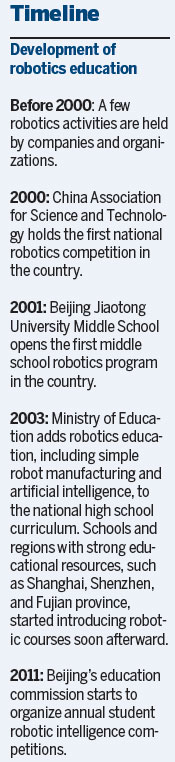
In Beijing, Jiaotong University Middle School introduced a robotics course as a requirement for all students and an elective for high school students in 2001, as the first school that opened a robotics course in China.
"We were the first of China's middle schools and high schools to introduce robotics as required courses, said Zu Haodong, a teacher at the Jiaotong University middle school and general referee of the national youth robotics activity. Zu added that regions with rich educational resources, such as Shanghai and Shenzhen, also started robotics classes at the time.
Zu was teaching electronics engineering-related elective courses then. He found that students had creative ideas but found it hard to make a product.
"In electronics engineering, innovation is a very high bar, requiring solid professional knowledge. ... Robotics is not, it's more like hands-on projects. Students can complete a robotics assignment based on their ideas and knowledge," Zu said, adding that robotics education connects students' ideas with facts.
Fifteen years later, Zu still remembers becoming motivated by students' feedback and reactions. The robotics program "became popular and students loved it", he said.
In the early 2000s, robotics education was still a "luxury", affordable only at schools with resources and a vision, like the Primary School Attached to Peking University and Jiaotong University Middle School.
With the development of modern technology, the Ministry of Education added robotics education, including simple robot-making and artificial intelligence, to the national high school curriculum as an elective in 2003.
The ministry also required physics courses to introduce robotics applications in daily life to students, incorporating robotics education in required courses.
Better-funded schools and cities gradually introduced robotics courses to their curricula. Education authorities also started to organize robotics competitions, encouraging more schools to get involved.
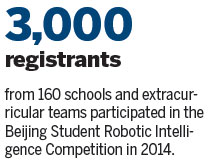
Since 2012, the Beijing education authority has held an annual student robotics intelligence competition, organized by the youth center in Haidian district and the Jiaotong University middle school.
In Beijing, some middle schools have started hiring students with robotics talent, shown by winning in robotics competitions, further heating robotics education.
Haidian district released its 2015 science and technology talent student recruitment plan in April, showing that all eight schools qualified to hire students with STEM (Science, Technology, Engineering and Mathematics) skills will hire students with skills in robotics.
However, in Zu's view, the heat of robotics education not only resulted from preferential recruitment policies, but from students' genuine interests.
"Once students have access to the program, they fall for it," he said.
Seventeen-year-old Zhu Guanzhou, a junior at Jiatong University Middle School, is a robotics fan who has been in the Robotics Club since entering high school.
"It is different from what we learned or did in other classes. ... There, we listen to the teachers, memorize what they said and do the exercises on paper. ... But when we make a robot, we have a written plan first, of course, including calculating the possible weight and preparing necessary parts.
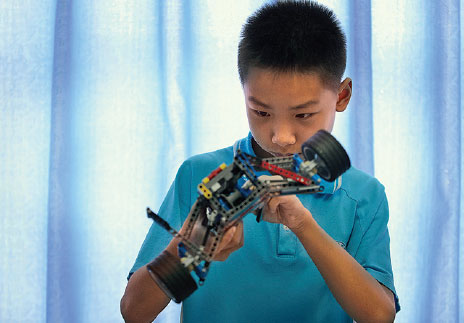
"The second step is to actually do it, not on paper but in the three-dimensional world. Then we test it, fail, revise the plan, test it again, fail again ... and repeat it until we succeed," Zhu said, demonstrating a robot he and his teammate made in March.
By assembling robots, Zhu also learned about physics in the real world.
"For example, I knew the equation P (power) equals F (force) times V (velocity) way before I started learning robotics. But when the ball missed the basket because our robot was not able to lift its arm at a certain height, I could see what 'lack of force' really means. We added more rubber bands to the robot to give it more power to raise the ball higher," Zhu said.
"Before, I could memorize the formulas but never really understood how they related to real life," he said.
Zhu's teammate, Chen Chaoyi, fell in love with robotics for another reason.
"Members of the team are from different grades. We hang out together. Sometimes we spend the whole night in the lab before a competition, just taking a nap if we got too tired. But weirdly, I rarely felt tired when we were doing a project. I often felt burned-out after the job was done," Chen said.
He has faith in his teammates, and each of them is responsible for one part of the whole project, he added.
"That's how I learned teamwork," he said.
Yang Derui, a sophomore at Beijing Jiaotong University majoring in communication engineering, joined the club in 2008 as a seventh-grader.
Although he attends college, Yang still goes to Jiaotong University Middle School every Thursday, giving lectures and helping students make robots.
"I like to share what I learned here with the youth. ... But they are more skillful than I was then," Yang said, adding that the development of robotics education has given students today more opportunities.
Yang still competes in college robotics competitions.
"I just love to do it," the 20-year-old said.
luowangshu@chinadaily.com.cn


Copyright 1995 - . All rights reserved. The content (including but not limited to text, photo, multimedia information, etc) published in this site belongs to China Daily Information Co (CDIC). Without written authorization from CDIC, such content shall not be republished or used in any form. Note: Browsers with 1024*768 or higher resolution are suggested for this site.
License for publishing multimedia online 0108263 Registration Number: 130349