 |
|
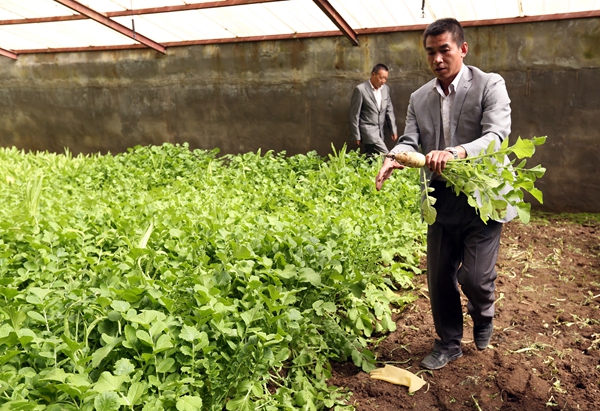
Villagers in Machali earn extra money from the vegetables they grow in greenhouses.[WANG JING/CHINA DAILY] |
In recent years, the county has undertaken anti-desertification measures on 280 sq km of land.
Since fishing was banned in Eling Lake, the biggest in Madoi, the water volume has risen and fish stocks have soared. The combined area of the Eling and Zhaling lakes has increased by more than 90 sq km since 2005.
The county government has hired more than 600 locals to act as eco-patrollers and guard against poaching and illegal fishing, and also to clear waste and litter.
Tugai, 46, and his team look after an area of 33 sq km. They patrol once a week and each trip takes two or three days, so they always carry tents and provisions. Although they usually ride motorcycles, the members often use horses to travel to the most remote spots.
Tugai used to be a herdsman on the reserve, but he and his wife, who has chronic pain in her joints, moved to the county town years ago. The couple receives a pasture subsidy of just 16,000 yuan a year, so Tugai was excited to hear that a new reserve-the Madoi National Park of the Yellow River Head-will be established in the county this year, because it will bring more government funding and improve the lives of the local residents.
Reclamation projects
In 2005, the State Council approved a plan to carry out emergency ecological protection in the Sanjiangyuan reserve, and by 2013, the nation had invested 7.5 billion yuan in reclamation and eco-restoration projects.
The plan, referred to as the first-phase project, included 22 sub-projects, which were mainly carried out in the reserve's core areas, covering about 40 percent of the entire region.
Compared with the three decades prior to 2014, the trend of ecological degeneration has been curbed, according to an evaluation report published last year by the Institute of Geographic Sciences and Natural Resources Research and a special evaluation panel formed by Qinghai province.
The measures have expanded grassland coverage by 124 sq km, and grass output in the reserve has risen by 30 percent. The area of desert has been reduced by 492 sq km, and water and wetland has expanded by 280 sq km. Water storage in the region rose by 6 percent compared with previous years.
Pedor has witnessed all the changes and their subsequent reversals. "The government's measures have worked, and now the local environment is almost how I remember it in the 1980s," he said.
According to Party chief Ren, Madoi received about 400 million yuan from the central government for eco-protection projects in Sanjiangyuan during the project, but when the different types of compensation for locals are added in, the true figure is close to 1 billion yuan.
The evaluation report-which was based on continuous monitoring since 2005-said restoring the ecosystem to its 1970s heyday remains a great challenge. It noted that recovered grassland accounted for just 9 percent of the area that has succumbed to desertification in recent decades, and 68.5 percent of the degenerated grasslands remained unimproved. Meanwhile, the area of wetlands and the annual runoff of the Yellow River are still nowhere close to their 1970s levels, while soil erosion has risen slightly because of a corresponding rise in rainfall during the period.
In 2013, the State Council approved the second-phase project to further protect the ecosystem. Unlike the first phase, the new program, which started in January last year, covers the entire reserve and has been granted central government funding of 16 billion yuan. It aims to realize the long-term goal of ecological protection and construction in the Sanjiangyuan area by combining natural recovery with eco-construction programs.
"We are shifting from emergency protection to regular, continuous protection," said Li Xiaonan, director of the Sanjiangyuan Office in Qinghai province. "Project-based protection will be replaced by more innovative and integrated institutions and mechanisms."
Li was optimistic about the reserve's future: "We have basically found a method that properly combines ecological protection with regional development and is in harmony with many ethnic traditions."
Contact the writers through liuxiangrui@chinadaily.com.cn


Copyright 1995 - . All rights reserved. The content (including but not limited to text, photo, multimedia information, etc) published in this site belongs to China Daily Information Co (CDIC). Without written authorization from CDIC, such content shall not be republished or used in any form. Note: Browsers with 1024*768 or higher resolution are suggested for this site.
License for publishing multimedia online 0108263 Registration Number: 130349