CBERS 4, developed jointly with Brazil, will be promoted among developing countries
A satellite jointly developed by China and Brazil became fully operational on Tuesday.
Control of the CBERS 4 remote sensing satellite was handed over to the China Center for Resources Satellite Data and Application at a ceremony in Beijing.
Developed by the China Academy of Space Technology and Brazil's National Institute for Space Research, the CBERS 4 was sent into Sun-synchronous orbit by a Long March 4B rocket from the Taiyuan Satellite Launch Center, in Shanxi province, in December.
A number of in-orbit tests have since been carried out.
The satellite will have its application promoted among developing countries, said a senior space program official.
"We have given data and images obtained by the CBERS 4 remote sensing satellite to more than 10 developing countries, especially those in Africa, to help with their land resources exploration, forest protection, hydropower projects and disaster prevention," said Tian Yulong, chief engineer of the State Administration of Science, Technology and Industry for National Defense, which oversees China's space programs.
As a product of the China-Brazil Earth Resources Satellite Program, CBERS 4 has taken more than 200,000 images of the Earth with its four cutting-edge cameras, such as the infrared multispectral scanner and wide-field imager.
It is the fifth in the CBERS satellite series. CBERS 1 was launched in October 1999, CBERS 2 in October 2003 and CBERS 2B in September 2007. The fourth, CBERS 3, went into space in December 2013 but failed to enter its preset orbit due to rocket malfunctions.
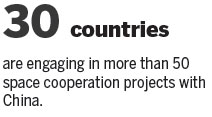
Tian said China is implementing more than 50 space cooperation projects with about 30 countries, and the Sino-Brazilian CBERS program is the most fruitful one.
"Scientists from both sides joined together to develop the satellite, and we share the technologies and data. We also plan to work with Brazil to develop new weather, communications and radar satellites within our space collaboration framework," he added.
In Brazil, images obtained by CBERS satellites have been used in many areas such as deforestation control and environmental monitoring in the Amazon region, according to Brazil's National Institute for Space Research.
The program's next satellite, CBERS 4A, is under development and is scheduled to be launched in 2018, the institute disclosed.
Valdemar Carneiro Leao, Brazil's ambassador to China, said the CBERS program has become an icon of South-South cooperation and a landmark in Sino-Brazilian space collaboration.
zhaolei@chinadaily.com.cn


Copyright 1995 - . All rights reserved. The content (including but not limited to text, photo, multimedia information, etc) published in this site belongs to China Daily Information Co (CDIC). Without written authorization from CDIC, such content shall not be republished or used in any form. Note: Browsers with 1024*768 or higher resolution are suggested for this site.
License for publishing multimedia online 0108263 Registration Number: 130349