 |
|
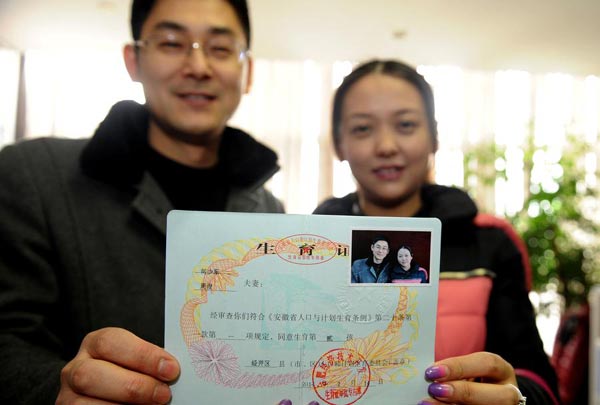
A couple gets the birth certificate for their second child in Hefei, Anhui province on Feb 14, 2014. [Photo/Xinhua] |
A low fertility rate and large labor outflow from Northeast China has led to an alarming aging society in the region, making it difficult to recover from economic slowdown, National Business Daily reported.
China’s recent sixth national census shows birth rates in Liaoning, Jilin and Heilongjiang provinces in the region are 1.03 percent, 1.03 percent and 1.0 percent, respectively, far below the national average rate of 1.5 percent and even lower than those in Japan and South Korea.
According to international criteria, a birth rate which is below 1.3 percent is defined as an ultra-low birth rate.
In addition to the lower birth rate, there is the outflow of the province’s labor force, which is bringing the population figure down.
Census data show a net outflow of 1.8 million people from the three provinces, most of whom are the young and middle-aged workforce migrating to more developed areas like Beijing and Tianjin.
In contrast, there was a net population inflow of 360,000 in the region in 2000.
As a result, the Northeast is confronted with the huge challenge of its fast-aging population.
By the end of 2012, there were over 5.7 million people ages 60 years and older in Heilongjiang Province, accounting for 14.8 percent of the total population. It is estimated that the aging population level in Heilongjiang will reach 19 percent by 2020 and be over 33 percent by 2045.
Experts say the decreasing population could slow economic revitalization efforts in the region, while, at the same time, the depressed economy can accelerate the outflow.
The three Northeast provinces ranked among the bottom five provinces in China for provincial GDP growth in 2014. Their average growth rate was slower than those in the Middle, Western and Eastern regions.
"The workforce aged 20 to 64 is the engine of economic growth. Japan and European countries had an economic crisis just before their labor growth reached the inflection point. Northeast China's economic growth slowed down after its population growth reached the point in 2013," said Yi Fuxian, a population expert with the University of Wisconsin.
He warned that what happened in the Northeast region might be seen again and again in other areas across the country in the years to come.
Fu Cheng, a researcher with the Jilin Academy of Social Sciences, suggested that China further ease its one-child policy to cope with the possible challenges.
The government relaxed the family planning policy in 2013, which allows couples to have two children as long as one of them is from a single-child household.
But Yi believes that it is hard to stop depopulation in China even though the family control policy has been abolished
In April 2014, Heilongjiang Province implemented the new second-child policy However, only 1.6 percent of the qualified spouses have obtained the second-child certificate so far, lower than the national average rate of 8.3 percent.


Copyright 1995 - . All rights reserved. The content (including but not limited to text, photo, multimedia information, etc) published in this site belongs to China Daily Information Co (CDIC). Without written authorization from CDIC, such content shall not be republished or used in any form. Note: Browsers with 1024*768 or higher resolution are suggested for this site.
License for publishing multimedia online 0108263 Registration Number: 130349