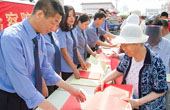
III. Women and Education
China actively promotes equality in education, adjusting the structure of education, adhering to the principle of gender equality, and working hard to guarantee equal rights and opportunities for both men and women to access education.
The gender gap in education has been markedly narrowed. The state implements the Compulsory Education Law of the People' s Republic of China and other relevant laws, regulations and policies, and takes practical measures to improve women' s education. It has implemented a special policy to ensure school-age girls enjoy equal access to compulsory education. In 2014, the net primary school enrolment rates of boys and girls were both 99.8 percent, meaning that China has achieved the United Nations Millennium Development Goals ahead of time. Women now enjoy greater opportunities in junior high school education and above, particularly further education. In 2014, the proportion of female students in junior high schools was 46.7 percent and that in high schools was 50 percent; in institutions of higher learning women accounted for 52.1 percent of undergraduate students, 51.6 percent of postgraduate students, and 36.9 percent of students studying for Ph.D. degrees.
The state has set up special funds to reduce the number of illiterate women. In 2013, the illiteracy rate for females at and over the age of 15 was 6.7 percent, 17.4 percentage points lower than in 1995; and the population of illiterate women fell by more than 70 million as compared with 1995. Women' s average years of schooling have increased, and the gender gap has narrowed. The Sixth National Census showed that the average years of schooling for women over the age of six were 8.4 years in 2010, 1.3 years more than in 2000, and the gender gap had narrowed by 0.2 year as compared with 2000.
More and more women have been receiving vocational education and skill training. The state has enacted and improved laws and policies on vocational education, allocating more funds in this regard, improving student aid policies and increasing the number of women receiving vocational education. In 2014, the number of women receiving secondary vocational education was 8.05 million, accounting for 44.7 percent of the total, and the number of females studying in technical secondary schools was 3.97 million, making up 53 percent of the total student body in similar schools. Around the country, 3.46 million women had received non-degree higher education and more than 20 million had received non-degree secondary education. The state launched a project to train farmers in new technology, a plan for cultivating highly skilled personnel, in addition to a number of training programs for improving the vocational skills of migrant workers, such as the Spring Tide Action and Sunshine Project, to meet the needs of different groups of women for their vocational development. In 2013, women who participated in skill training programs organized by government training institutions accounted for 43 percent of the total number of trainees.
Women of ethnic minority groups, girls in remote poverty-stricken areas and other female groups now enjoy equal access to educational resources. The state has adopted proactive policies to set up vocational schools specially catered to ethnic minority students, and introduced preferential measures for targeted enrolment, substantially expanding ethnic minority women' s access to educational resources of various types and at all levels. The state has developed special education programs for poor girls and schoolgirls, ensuring girls in remote and poor areas equal access to education. It has been accelerating the construction of boarding schools in rural areas, thereby improving the study and living conditions of rural girls. Specific policies have been introduced to provide education for migrant children where they move. China also attaches importance to special education, increasing disabled women' s access to educational resources of various types and at all levels; as a result, disabled women have improved access to education.
Principles and concepts of gender equality are gradually extending into teaching and scientific research. More and more schools have begun to introduce the idea of gender equality in educational content and teaching methods, and some primary and high schools are now offering courses in gender equality, directing younger students to relate to the idea of gender equality. Gender equality has also been introduced to some teacher training programs and normal school courses, in order to enhance teachers' awareness of gender equality. More women now occupy positions of decision-making and management in schools and educational administrative departments of all types and at all levels, greatly improving women' s participation in teaching, management and some other areas of higher education. In 2014, the proportion of female teachers in institutions of higher learning was 48.1 percent, an increase of 18.1 percentage points over 1995. Women' s studies continues to strengthen as a discipline in institutions of higher learning. Currently, more than 100 colleges and universities offer in excess of 440 courses on women' s studies and gender equality, and the number of master' s and doctoral programs on women' s studies continues to grow. The state has also included gender equality in the national plans of philosophy and social sciences to support research in gender equality and women's issues.


Copyright 1995 - . All rights reserved. The content (including but not limited to text, photo, multimedia information, etc) published in this site belongs to China Daily Information Co (CDIC). Without written authorization from CDIC, such content shall not be republished or used in any form. Note: Browsers with 1024*768 or higher resolution are suggested for this site.
License for publishing multimedia online 0108263 Registration Number: 130349