V. Women and Decision Making
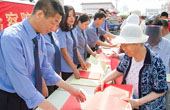
China has formulated and implemented laws, regulations and policy outlines to ensure that women enjoy equal political rights with men, which has resulted in a higher level of female participation in politics and a greater role played by women in decision making and management of state and social affairs.
Improving laws and policies that boost women's participation in decision making and management. China has formulated and implemented proactive measures to boost women' s participation in decision making and management, which, in turn, has helped increase the number and proportion of women in decision-making and managerial positions. The detailed implementation rules of the Law on the Protection of Rights and Interests of Women and the Electoral Law adopted by various places across China all include explicit provisions on the proportion of women candidates to local people's congresses. The state has formulated a special plan that defines the goals of and requirements for training and selection of women officials, and has taken concrete measures to increase the number and proportion of women officials at various levels. The Organic Law of the Village Committees of the People' s Republic of China rules that "female villager representatives should make up more than one third of the village committee." The Program for the Development of Chinese Women (2011-2020) states that "by 2020 the percentage of women in village committees will exceed 30 percent, and that female village committee heads should exceed 10 percent"; and that "the ratio in neighborhood committees should be around 50 percent." The Election Procedure of Village Committees issued in 2013 specifies that "village committee candidate lists should include a certain number of women; if not, those women who get the most votes should be candidates." This show that a number of measures has been adopted to improve the representation of women in village committees.
Women's participation in decision making and management has markedly improved. China values the role of women in people's congresses by improving their representation in the ranks of deputies to people's congresses at various levels. The ratio of women deputies to the first session of the 12th National People' s Congress in 2013 was 23.4 percent, 2.4 percentage points higher than 20 years ago; ethnic minority women deputies made up 41.3 percent of the total number of ethnic minority deputies. China sets store on improving women' s participation in socialist consultative democracy and the role of representatives of women's federations and women delegates to the Chinese People' s Political Consultative Conference (CPPCC). The proportion of women members at the first session of the 12th CPPCC national committee in 2013 was 17.8 percent, 4.1 percentage points higher than 20 years ago. The ratio of female CPC members also markedly increased, reaching 24.3 percent, an increase of 8.7 percentage points from 1995. The ratio of women members in all other political parties (other than the CPC) is higher than 20 years ago. The number of women participating in the management of state public affairs keeps increasing. In 2013, the female employment ratio in central government agencies and their subsidiaries reached 47.8 percent. In recent years, the number of newly employed women civil servants has also increased steadily at local levels.
Women's extensive participation in the development of grassroots democracy. In 2013, female representation in village committees was 22.7 percent, an increase of 7 percentage points from 2000; the ratio of women as village committee heads and representatives also increased significantly, making women an important force in primary-level rural governance. In 2013, women made up 48.4 percent of neighborhood committees and female heads of neighborhood committees represented 41.5 percent. Female employees also play an active part in democratic management and supervision in enterprises. In 2014, female workers represented 38.1percent of the trade union members, female employee representatives accounted for 29.3 percent of workers' congresses, and female representatives made up 40.1 percent and 41.5 percent of boards of directors and regulatory committees, respectively.
The influence of women and women's organizations in the development of the country's democratic politics keeps growing. China supports and encourages women to take part in the management of state and social affairs in an orderly manner by expanding the scope and channels for such participation. Women deputies to people's congresses and the CPPCC women members have taken an active part in the administration and discussion of state affairs by actively introducing bills, suggestions and motions to help improve gender equality and women' s development. The state sets store by gender equality in decision making, enabling leading women officials to play an important role in decision making and management. Women's federations participate in legislation and consultative democracy. They have pressed for incorporating gender equality in the formulation and implementation of policies, laws and regulations, and urged to give expression to the principle of gender equality in the formulation and amendment of the Law on the Protection of Rights and Interests of Women and the Anti-domestic Violence Law of the People's Republic of China. Women's organizations are a force of growing importance in primary level social governance. In recent years, using the venues of rural village committees and urban communities, women's federations have established more than 700,000 service centers (known as "Women's Home") to connect and serve women effectively, and to help with primary level social governance. Other women' s organizations also take an active part in democratic governance and supervision.


Copyright 1995 - . All rights reserved. The content (including but not limited to text, photo, multimedia information, etc) published in this site belongs to China Daily Information Co (CDIC). Without written authorization from CDIC, such content shall not be republished or used in any form. Note: Browsers with 1024*768 or higher resolution are suggested for this site.
License for publishing multimedia online 0108263 Registration Number: 130349