 |
|
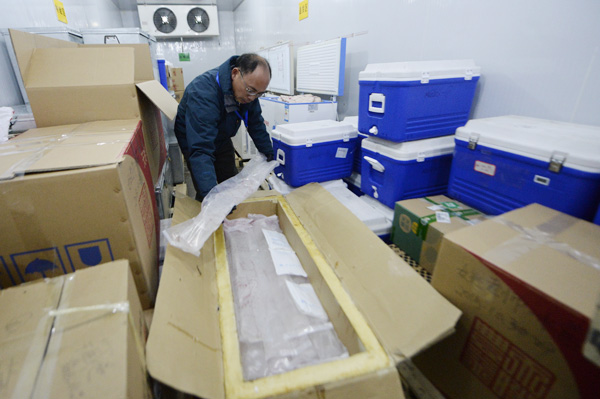
Six metric tons of ice cores drilled on the Qinghai-Tibetan Plateau are kept in a refrigerated store in Beijing. [Photo by Wei Xiaohao/China Daily] |
By reading the rings of trees, you can get climate information dating back hundreds or even thousands of years.
If you want to see climate changes over hundreds of thousands of years, however, you have to look at ice.
A team of scientists from five countries recently climbed onto the Qinghai-Tibetan Plateau and drilled six metric tons of ice cores-the oldest ice on Earth's so-called Third Pole.
"These ice cores are one of the most precious things in the world. Since glaciers are retreating fast, in the near future the ice will disappear together with the information it holds," said Yao Tandong, director of the Chinese Academy of Sciences' Institute of Tibetan Plateau Research.
Yao led the team of scientists from China, the US, Russia, Italy and Peru to the Guliya ice cap near the junction of the Tibet and Xinjiang Uygur autonomous regions in late August. They spent more than two months at altitudes between 6,000 and 7,000 meters collecting six ice samples from 308 meters deep.
In late October, the cores were shipped from Lhasa, Tibet, to a refrigeration house in Beijing. Some will be transported later to the United States for further study.
Scientists from several countries will assess the climate signals embedded in the ice over the last 100,000 years by measuring high-resolution images of dust, trace elements and black carbon at selected intervals of the cores, according to an e-mail to China Daily from Lonnie G. Thompson, a paleoclimatologist from Ohio State University in the US.
"On the longer time periods, we hope to document abrupt climate variations, both past and present, and establish tightly constrained time scales on the ice cores through the use of new dating techniques that did not exist in 1992. We also hope to assess the regional characteristics of climatic and environmental variability over decades to millennial time periods," Thompson said, "and to determine how they compare with conditions elsewhere, including the Polar Regions."
In 1992, scientists visited the Guliya cap once and drilled some ice cores at the same site. They are currently preserved at a refrigeration house in Lanzhou, Gansu province.
An analysis of those ice cores was published in the journal Science in 1997 that was widely discussed by the scientific community.
"Last time we focused more on mining climate information over hundreds of thousands of years from the ice core. This time we will also emphasize the change of temperature, precipitation, dust and plants over the past century," said Wu Guangjian, a researcher at the institute.
Yao, the institute's director, said there is much to learn by comparing the new cores with the old ones-for example, finding out if climate change in other region of China influenced glaciers over the past two decades, or understanding the reasons for retreating glaciers.
"The comparison on climate change over a short period is more meaningful on the Qinghai-Tibetan Plateau compared with Antarctica, because the high accumulation on the plateau makes it easier to identify the time scale of climate change," Yao said.
Plateau offers glimpse of ancient conditions
The Qinghai-Tibetan Plateau is gaining significance for providing early indications of climate and environmental changes.
Known as the Third Pole region, the area is a hot spot for climate research because it has the deepest levels of ice outside of the north and south poles.
In 2009, the Chinese Academy of Science initiated the Third Pole Environment Program to focus international research on key environmental aspects of the plateau and nearby regions.
Recently, scientists from China, the US, Russia, Italy and Peru drilled six tons of ice core samples from the plateau for scientific research.
Lonnie G. Thompson, a paleoclimatologist from Ohio State University in the US, said that recovering the climate records of the Third Pole Region is as important as a "global salvage mission".
"These ice archives of our past are disappearing quickly across the Third Pole Region due to mass loss, often from the surface down. It is important to recover these records before they are lost forever," he said.
Vladimir Mikhalenko, a research professor from the Institute of Geography, Russian Academy of Sciences, said the ice cap is a key to solving the puzzles of Tibet's climate.
"The combination of low ice temperature, surface snow accumulation rate, and 300 meter ice thickness allow (for the expectation of) finding the most ancient ice at the Tibetan Plateau.… If our expectations are confirmed by ice core analyses we can reconstruct climate and environmental conditions in Tibet for many thousand of years. This result will be comparable with Antarctic and Greenland ice core records," said Mikhalenko.


Copyright 1995 - . All rights reserved. The content (including but not limited to text, photo, multimedia information, etc) published in this site belongs to China Daily Information Co (CDIC). Without written authorization from CDIC, such content shall not be republished or used in any form. Note: Browsers with 1024*768 or higher resolution are suggested for this site.
License for publishing multimedia online 0108263 Registration Number: 130349