|
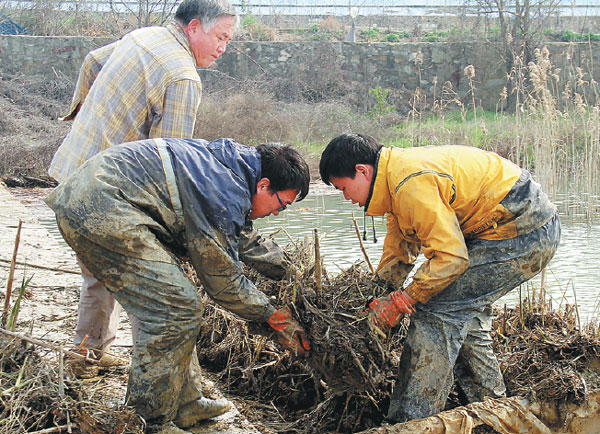
Yu Dan (left) and two students move seedlings for replantation in another part of the lake as part of an ecosystem restoration experiment in 2014.Photo Provided to China Daily |
Dedication and passion
In 1992, concerned by the worsening water quality, Yu joined Wuhan University and settled on the island to oversee a team of researchers investigating the lake's ecosystem. "It was much more convenient for me to build experimental facilities on the island," he said.
His lonely vigil is fired by dedication and a passion to restore the lake's ecosystem.
Having collected more than 180,000 samples from across the country, Yu has built a database of aquatic plants and selected the most appropriate species to bring life back to the lake.
"We bring native plants such as Potamogeton Maackianus (a type of pondweed), which have long been crowded out by invasive species, back to the lake," he said. "By restoring the underwater vegetation with these almost extinct local species, we were able to bring the environment back to its original state."
Through years of research, Yu discovered that plants known as aquatic macrophytes should be planted during winter so they will purify the water before summer, the main season for outbreaks of blue-green algae.
A typical day for Yu involves getting up at 6:30 am, patrolling the lake, planting macrophytes and collecting plant samples. He rushes lunch and dinner, and usually works until about 8 pm.
The harsh environment proved too much for most of his student researchers, and only a handful stayed with Yu until they finished their studies.
"We need to get up early to collect specimens and go on field trips with the professor," said Huang Xiaolong, 27, a PhD student in Yu's current research team.
"The work demands actual physical strength; planting aquatic macrophytes requires diving to the bottom of the lake and staying there for more than 30 seconds. We have to plant each macrophyte ourselves," he said, adding that he has not only learned a lot about aquatic plants, but also gained a sense of how to appreciate their beauty.
Xu Xinwei, 40, associate professor of ecology at Wuhan University, was one of the few students who stayed with Yu in the early days. He also worked with Yu as a graduate student, and the two men have now been conducting their research for more than 10 years.
"Professor Yu's research is based on his long experience, well-thought-out plans and his dedication," Xu said. "His research could have a long-term impact on future ecological studies."
To protect the macrophytes, Yu's team plants lotus and water chestnuts, which can be harvested and sold by local residents, reducing the need for them to catch fish or interfere with other plant life, "so that the restored region will not be affected by human activity", according to Yu.
"We do this purely for the public good, not for economic return. We have to help the local residents find ways of making a living while ensuring that the ecosystem is more sustainable," he said.


Copyright 1995 - . All rights reserved. The content (including but not limited to text, photo, multimedia information, etc) published in this site belongs to China Daily Information Co (CDIC). Without written authorization from CDIC, such content shall not be republished or used in any form. Note: Browsers with 1024*768 or higher resolution are suggested for this site.
License for publishing multimedia online 0108263 Registration Number: 130349