The government is carrying out the first survey of minors in the rural areas with the aim of ensuring they are safe and have access to education, as Luo Wangshu reports from Huarong, Hunan province.
 |
|
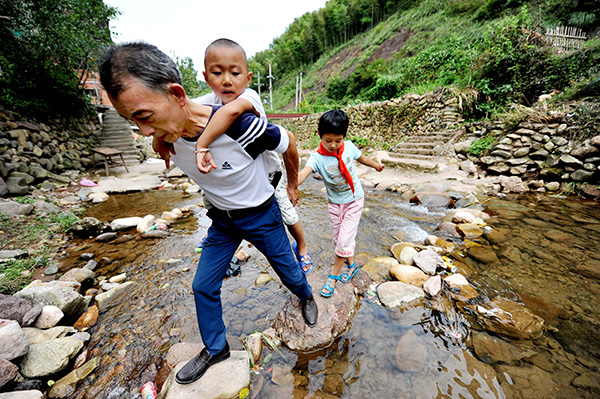
Two left-behind children follow their teacher to school in a mountainous area of Jiangxi province. ZHUO ZHONGWEI/CHINA DAILY |
Reporter's log: Too much, too young
Late last year, Fan Juxiang made a life-changing decision. The 27-year-old migrant worker quit her job in Zhejiang province in East China, and made the 1,100-km journey home to Huarong, a village in the central province of Hunan, where she had left her 3-year-old son to be raised by his grandparents.
Before that, Fan's life had been uneventful, and she was almost a stereotypical woman from China's rural areas. Fan was raised as a "left-behind child", completed a basic education, left the countryside to live in a city as a migrant worker, returned home to get married, had a child and then left home again.
"I was a left-behind girl when I was young. I understand how hard life is as a left-behind child, and I do not want my baby boy to have the same miserable childhood that I did," she said, reflecting on her decision to return home.
The cost of urbanization
The authorities are hoping that other migrant workers will follow Fan's example, and governments at all levels have created environments designed to persuade them to return to their homes so they can be with their children and earn a living.
Although China has experienced rapid industrialization and urbanization since the 1980s, the pace of change has accelerated in the last 20 years. That has led millions of rural residents to flock to large cities in search of work, leaving their underage children in the care of grandparents, relatives, or even to fend for themselves.
Now the government is carrying out the first nationwide survey of left-behind children with the aim of forming an accurate picture of their numbers nationwide to provide better support for those in need.
The latest official statistics, released by the All China Women's Federation, show that China had about 61 million left-behind children in 2013, although the number may have been as high as 80 million, depending on the definition of a left-behind child-that is, whether one or both parents are absent.
The survey, which started in March and will finish at the end of July, is being undertaken by the ministries of civil affairs, education and public security. It will form the basis of a database that will allow arrangements to be made to ensure that the children are safe and have access to education. The results are due to be released in August.
Song Minghong, a local government official in Huarong, has been collecting details about left-behind children in the village.
"It's not a difficult job for us because we know the distribution of left-behind children in our village. We are updating existing data to include the latest changes," Song said, adding that he usually visits about 10 families a day.
When we spoke, Song had been sitting with 59-year-old Duan Zeben for about 30 minutes, recording information about Duan's grandchildren and cross-checking the existing information.
Duan's son and daughter-in-law, who both work in big cities, have left their two children, ages 4 and 18 months, at home, so they fall into the main group of interest. The survey focuses on children younger than 16 whose parents are migrant workers and absent from home, or families in which one parent is a migrant worker and the other is too ill to care for the children.
The information gathered includes date of birth, sex, education, ID number, residential address, health status, and whether the children attend boarding schools. Details of the parents' working addresses, the major source of the family's income and the children's registered guardians are also being collated.
"The survey is designed to help us understand the situations in which left-behind children live so we can better support those in need," said Wang Jinhua, director of the social affairs department at the Ministry of Civil Affairs.
According to Guan Xinping, a professor of social policy at Nankai University in the northern port city of Tianjin, the survey is the first substantive step toward comprehensively providing care and protection for left-behind children.
"The survey will not only present a clear picture of the real situations of these children in different regions, but also provide a snapshot of their specific individual conditions," he said, adding that the data will be used to guide decisions made at both the national and local level.



Copyright 1995 - . All rights reserved. The content (including but not limited to text, photo, multimedia information, etc) published in this site belongs to China Daily Information Co (CDIC). Without written authorization from CDIC, such content shall not be republished or used in any form. Note: Browsers with 1024*768 or higher resolution are suggested for this site.
License for publishing multimedia online 0108263 Registration Number: 130349