 |
|
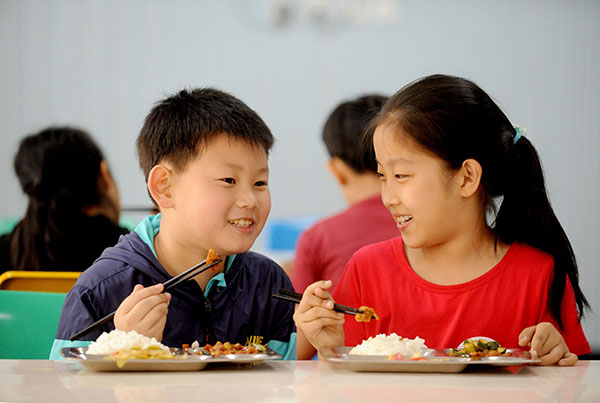
Students dine in May at Shenyang Railway No 3 Primary School, a model school for student nutrition in Liaoning province. ZHANG WENKUI/XINHUA |
More than 33.6 million students living in poverty have become healthier overall as a result of government subsidized meals, but improved food availability and safety remain top priorities, along with health education, the Ministry of Education said.
Fifteen organizations, including the finance and education ministries, launched a nutrition drive in 2011 to help needy children from first to ninth grade.
Since then, more than 159 billion yuan ($23.7 billion) has been spent on improving meals and dining spaces in 137,000 schools in 29 provinces. The program covers more than 33.6 million students, according to the program's assessment report published on Tuesday.
"We used to only eat what was most abundant in the market, and sometimes our menu wouldn't change for days," said Li Bo, an elementary schoolteacher from Cangxi county, Sichuan province. "Now we have the means to diversify our meals and provide a balanced diet for our children."
The meals consist of locally grown foods that are rich in protein and fiber.
"Thanks to the program, children in rural areas are healthier and happier every day," said He Xiuchao, the director of educational supervision at the Ministry of Education.
However, not every school can implement the plan effectively. An online database of information related to the program, compiled by the Children Center at the China Development Research Foundation, said schools in the Xinjiang Uygur and Tibet autonomous regions in general had the most comprehensive meals, while some schools in Hunan and Gansu provinces could only provide a sausage or a carton of milk.
"Xinjiang and Tibet, which have a large ethnic population, enjoy more subsidies than other provinces, hence the better food," said Du Zhixin, director of the center.
Some schools will buy snacks to replace proper meals, but that generally costs more and adds little nutritional value, Du said. However, most children don't know the harmful effects. More than 66 percent of students spent at least 1 yuan ($0.15) on a snack every day, and close to half consume soft drinks.
Deng Fei, the founder of the Free Lunch Foundation, an organization that provides free meals for rural Chinese students, expressed concern that "apart from food additives, some snacks sold by local stores are counterfeit or even expired, which can be harmful to children".
Besides strengthening education effort, Deng suggested that government and schools should focus on improving the quantity and quality of meals.
"Food availability shouldn't be a problem," he said. "Schools can buy food from local residents. This not only helps alleviate poverty in the community but also ensures a sustainable source."
Further, schools need to have the authority to negotiate deals and be transparent in the process, Deng said.



Copyright 1995 - . All rights reserved. The content (including but not limited to text, photo, multimedia information, etc) published in this site belongs to China Daily Information Co (CDIC). Without written authorization from CDIC, such content shall not be republished or used in any form. Note: Browsers with 1024*768 or higher resolution are suggested for this site.
License for publishing multimedia online 0108263 Registration Number: 130349