Nanjing's tower of strength
|
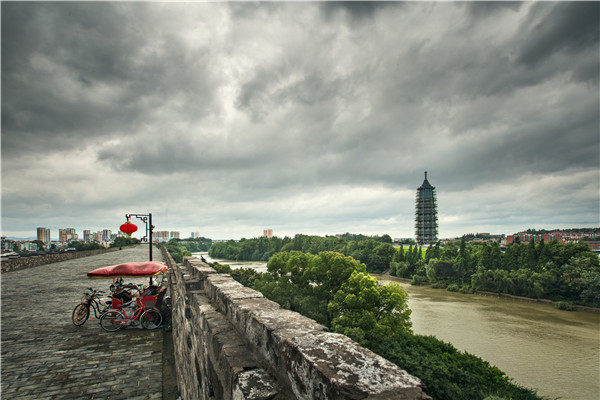
The new Porcelain Pagoda in Nanjing, Jiangsu province.Xue Xiaohong / For China Daily |
The construction of the Porcelain Pagoda in Nanjing, Jiangsu province, was ordered by the Emperor Yongle during the Ming Dynasty (1368-1644) to express his gratitude to his mother. The Grand Bao'en Temple, where the pagoda is located, literally means "Temple of Repaid Kindness".
It took the country's best architects 17 years to complete the 78.2-meter-high octagonal structure, which was covered by colorful glazed porcelain bricks made by the most skillful workers of the time. The building was renowned as one of the seven wonders of the medieval world.
Zhou Daoxiang, former curator of the Imperial Examination Museum of China in Nanjing, said the largest bricks in the pagoda could weigh as much as 150 kilograms each.
"Nowadays, workers are unable to produce such large porcelain bricks because the skills to make them have been lost," Zhou said.
"Some ancient porcelain bricks were thicker than 50 centimeters. We've experimented, and even good workers today can barely make bricks thicker than 5 cm. When the surface of the porcelain brick was well-sintered, or compacted, the inside was still raw. Also, the colorful surfaces of the porcelain bricks we duplicate can last as long as 10 years before they begin to fade and crack. But some of the remnants of the ancient porcelain bricks used on the pagoda still look good after hundreds of years."
Images of animals, flowers and an Buddha could be seen on the sides of the original nine-story tower. Inside, a 184-step staircase led visitors to the top of what was then the tallest building in China, according to historical documents.
At night, more than 100 lamps were hung from the tower, while bells hung at its corners during the day tinkled softly as the wind blew.
In his 1839 story, The Garden of Paradise, Hans Christian Andersen, the Danish fairytale writer, mentioned a teenager called East Wind who flew home from China. He told The Wind, his mother: "I came back from China, where I danced for a while around the Tower of Porcelain and rang all the bells".
After numerous Western adventurers described the pagoda in their travel stories, it became one of China's most famous landmarks.
Johan Nieuhof, a Dutchman who worked for the East India Company, described the pagoda in his book, Chinese Memoirs, which was published in 1665. The book became popular in Europe, and was translated into several languages. Many artists and architects created their own works based on sketches in the book, including Sir William Chambers, who designed the Great Pagoda in the southeast corner of London's Kew Gardens.
Martino Martini, an Italian Jesuit missionary who came to China to preach in 1643, published his own book, which contained descriptions of the Nanjing pagoda, 10 years before Nieuhof's. However, the numerous sketches and explanations of recent world events contained in Nieuhof's book led to it becoming more popular.
The top four floors of the pagoda were destroyed by lightning in 1801, and about 50 years later, the Buddhist images were removed from the restored tower and the inner staircase was smashed during the Taiping Rebellion, a revolt that lasted from 1850 to 1864.
After the rebels occupied Nanjing, they removed the tower's golden, pineapple-shaped top, intending to use it as payment for military expenditures. The rebels destroyed the rest of the tower in 1856, and many pieces were used in the construction of other buildings.
In 2010, with a donation of 1 billion yuan ($156 million) from Wang Jianlin, founder of the Dalian Wanda Group and one of China's most-successful entrepreneurs, a replica of the pagoda was built, set in a dedicated heritage park. The facility was opened to the public in 2015.
Instead of glazed porcelain bricks, the replica was built from steel girders and glass to protect an underground palace that was unearthed in 2008. Many relics, including supposed fragments of Buddha's skull bones, and the remains of several other eminent monks, astonished the country and Buddhists worldwide.
Standing on the platforms that adorn each story of the tower, visitors can enjoy wonderful views of Nanjing, including the ancient city walls and the Qinhuai River. The bells hanging on the corners still tinkle pleasantly when the wind blows.