New realities 'rebuild' Beijing's lost city gates
Some of the capital's long-gone landmarks are being recreated in the virtual world. Yuan Quan reports for Xinhua China Features.
 |
|
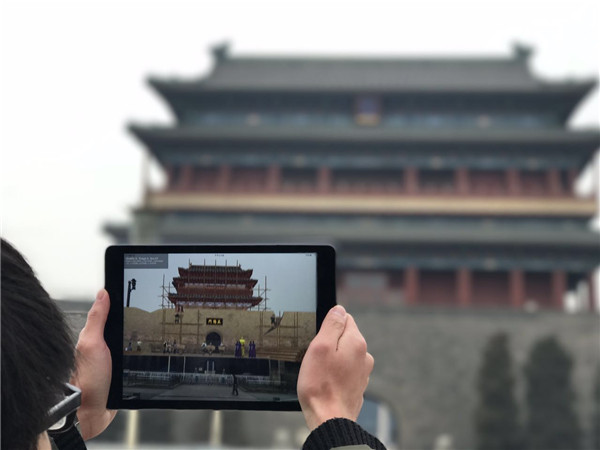
In the 1960s, the city planners left just "one and a half" city gates. The "one gate" is Zhengyangmen, on Beiijng's north-south axis at the south end of Tiananmen Square. Built in 1419, it is also known as Qianmen, or "Front Gate".[Photo provided to China Daily] |
Advanced technologies are bringing China's past to life - and it all started with a little girl's question for her father.
People in Beijing can now see how the city's long-demolished gates appeared almost 70 years ago by using their smartphones to overlay historical scenes on photos of the actual sites in the modern metropolis.
The technology used is augmented reality, which enables people to scan an object with their smartphone to produce a three-dimensional animation of the structure that appears to overlay the actual site.
These virtual history lessons were the brainchild of Li Yingchao, 34, an augmented reality engineer with search engine Baidu, but the inspiration came from Miduo, his 4-year-old daughter.
One day, Li and Miduo were traveling on Beijing's Subway Line Two, which follows the route of the old city wall, when the girl asked, "Why do so many stops have the word men (gate) in their names?"
The question puzzled Li. He knew that eight subway stations were named after various dismantled gates, but he had no idea why.
 |
|
Li Yingchao and his daughter Miduo.[Photo provided to China Daily] |
The Old City
Beijing, China's capital since the 13th Century, once had 20 city gates. They were built as key passageways for different social classes - including the imperial family, civil and military officials, members of the public and even criminals - to come and go from the city.
During the Ming (1368-1644) and Qing (1644-1911) dynasties, Beijing had nine large city gates. They were mostly pulled down in the 1960s, along with the old city wall, to make way for new roads and subways, and to expand the metropolis.
Records show the gates were more complicated than they appeared. A city gate, topped by a two-story tower, usually comprised a gatehouse, an archers' tower and a barbican.
The city planners only left "one and a half" city gates. The "one gate" is Zhengyangmen, on Beiijng's north-south axis at the south end of Tiananmen Square. Built in 1419, it is also known as Qianmen, or "Front Gate".
Bereft of its side walls and barbicans, Qianmen has been restored with a new face. The "half gate" is the Deshengmen archers' tower.
This was news to Li. Born in Shandong province in East China, he arrived in Beijing in 2000 to attend college. Later, he found a job in the capital, married and had a daughter. He knew little about the city's past.
Long working hours meant he seldom played with his daughter. He decided to use the augmented reality technology that he and his colleagues used as a marketing tool for companies such as L'Oreal and Mercedes-Benz to "build" a city gate.
His idea resonated with his team of more than 20 developers. Like Li, they mostly hail from other parts of the country, and with an average age of 28, they had little time to study the history of their adopted home city.
In November, Li and his colleagues invited artists to paint pictures of the nine lost gates, based on written materials they discovered online, then posted them in stations. The group invited subway commuters to scan the pictures to get a visual and aural description of the area they were passing through. The visuals were accompanied by a short commentary on the vanished buildings.
When the project was launched in December, passengers loitered in crowded stations and tried the technology. Some enjoyed taking selfies with the virtual models.
In late January and February, a painting was posted at Chaoyangmen subway station on Line Two.
The project can now be seen at the Beijing Planning Exhibition Hall at an exhibition called Technologies Awaken City Memories.
"It (augmented reality) helps people to learn about the city's history and the changes made," Hu Daxin, the hall's deputy curator, said. "The more you learn, the stronger your sense of belonging."
As Beijing has expanded and its population has risen, the subway's tentacles have stretched further and become more complex. Currently, there are 19 lines, covering 574 kilometers.
The demolition of the city gates and walls to build subways and roads has been a controversial topic for decades.
A shared duty
When the initiative was shared online, it became a public project. "I was born in Beijing in the 1940s, and I saw the city gates - great world heritage treasures," read a post on WeChat. "They were a great loss. When my child told me about their 'revival', I wanted to see it."
However, some people criticized the project because it provided inaccurate information.
The tech engineers received emails and comments saying there were many mistakes: some city walls were painted with angles, when they had actually been arched; the nine gates had encircled the inner city, but the engineers had lined them up; and they had ignored the details on each gate.
In response, Li and his colleagues pointed out that the paintings were works of art, so they could not be 100-percent accurate. The explanation cut no ice with some observers, though, with one commenting: "Mistakes will mislead the public. You cannot play with history."
Li and his colleagues realized how serious the issue was. "We had a bigger responsibility," he said.
The team invited scholars to give talks, and spent days in libraries to study the city's history. They also continued to test their design and decided to use black-and-white photos of the designated spots. "Photos are real, even though they are not much brighter than the paintings," Li said.
Preservation
Li's project isn't the first attempt to "revive" the city gates. Many Beijingers had already tried to bring them back to life in a variety of ways.
For example, a young photographer made a series of pictures of the gates looming between real buildings and with the busy Second Ring Road below.
He superimposed an old photo of the gates on a picture of the location as it appears today.
Moreover, a retired teacher painted pictures of many razed buildings, including the gates, based on his childhood memories. The paintings have been displayed in museums.
"I have realized that all citizens share a duty to protect the city's cultural heritage," Li said.
His daughter has benefited too. She now knows the different functions of all nine gates, and described the virtual model in her palm as "magic".