Former HK chief says 'one country, two systems' undoubtedly a success
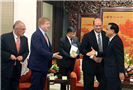
HONG KONG -- The implementation of the "one country, two systems" principle in Hong Kong is "undoubtedly" a success, former chief executive Tung Chee-hwa said in a recent interview, while confident in the metropolis's ability to deal with future challenges.
Tung was sworn in as the first chief executive of the Hong Kong Special Administrative Region (HKSAR) when Hong Kong returned to China from British rule on July 1, 1997.
Calling the handover the "most unforgettable moment" of his life, Tung, now vice chairman of the National Committee of Chinese People's Political Consultative Conference, said, "Watching the Union Jack being lowered and the five-star red flag of China gradually rising, I, a 60-year-old Chinese national, was excited and touched."
This year also marked the 20th anniversary of implementing the Basic Law of the HKSAR. Enacted in accordance with China's Constitution, the Basic Law specifies the guidelines of "one country, two systems" and "Hong Kong people administering Hong Kong" with a high degree of autonomy.
Over the past 20 years, the capitalist regime in Hong Kong has not changed, neither have people's lifestyles, Tung said, adding that the law has remained almost the same, and both the economy and society have maintained steady growth.
He noted that the rule of law, a core value of Hong Kong society, has been firmly upheld, something the central government has valued and safeguarded
Tung said most Hong Kong residents are aware of the significance of the "one country, two systems" principle and gave heartfelt support to it.
Since 1997, the HKSAR has confronted many challenges. Tung recalled the Asian financial crisis, which broke out in Thailand in July,1997 and soon after swept through Asia rocking Hong Kong.
He also mentioned the SARS outbreak in 2003 and the global financial crisis in 2008.
"Over the 20 years, we have gone through many difficulties. But as we have the Motherland to back us up, dealing with these problems became a little easier," he said.
The past two decades also saw closer ties between Hong Kong and the mainland, with more Hong Kong residents speaking mandarin and learning more about the country and its fast development, he said.
Hong Kong previously depended mainly on trade with America and Europe, but now it has closely integrated with the mainland, and more Hong Kong residents have chosen to develop their careers there, Tung noted.
Tung pointed out that the success of the "one country, two systems" was also recognized by international society. "Many foreign friends said to me with envy, that we have the advantage over them because of 'one country, two systems,'"
However, the 80-year-old admitted Hong Kong still faces some deeply rooted problems, including high property prices, a wide gap between the rich and the poor, difficulty for young people to climb the social ladder and industrial hollowing-out.
But Tung said he remains optimistic about Hong Kong's future. In his view, Hong Kong continued its robust economic growth despite encountering several shocks since 1997, and it has a sufficient fiscal reserve, providing conditions to resolve its problems.
Over the past five years, Hong Kong's GDP grew more than a nominal 5 percent each year, Tung said, "We can solve a lot of problems when we have 4 to 5 percent growth."
On the other hand, Tung believed Hong Kong should seize opportunities brought by China's development and make good use of its strengths in areas such as trade and finance, yuan internationalization, and the Belt and Road Initiative.
He also hoped Hong Kong, a city where the East meets the West, can serve as a bridge for cultural exchange and shed light on the integration of different cultures around the world.





- First specialty orchid seedlings sent to US from Chinese mainland
- Graft fugitive on 'red list' surrenders
- Former HK chief says 'one country, two systems' undoubtedly a success
- China endeavors to promote cooperation in combating desertification: envoy
- China sees fewer production accidents in Jan-May