Comments()
  Print
Print  Mail
Mail  Large Medium Small
The 15 years since Hong Kong was handed back to China have seen significant increases in the number of Hong Kong residents taking up residence in Shenzhen. They may be eager youth, looking for a stronger career path; they may also be elderly folks, seeking a higher-quality retired life. Anyone from either group is usually referred to as: Shenzhen-Hong Konger. Michelle Fei reports.
 |
|
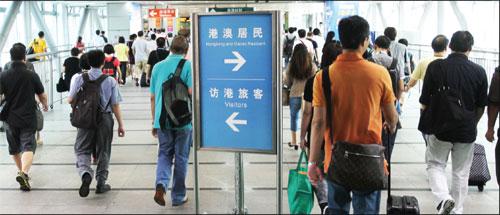
In 2009, on average some 5.5 million passenger trips were made between Hong Kong and the mainland on a daily basis. [Photo/China Daily] |
Tong Chun-yip was amused by the term "Shenzhen-Hong Konger" when he first encountered the concept on the Internet.
The 35-year-old Hong Kong resident who was born in Shanghai and later moved to the city with his parents, eventually settled in Shenzhen after marrying a woman from the mainland.
"Every time people asked me 'where are you from', I would hesitate for a few seconds and then answered 'I'm a Hong Kong resident'," said Tong.
"I myself confused sometimes about my identity, as well. Frankly speaking, I don't see myself specifically belonging to either city — Hong Kong or Shenzhen. Maybe the term 'Shenzhen-Hong Konger' is more accurate," said Tong, answering in perfect mandarin without any accent as a Cantonese speaker.
The term "Shenzhen-Hong Konger" was created by the media and in recent years became widely used in the cyber world. It refers to Hong Kong residents who make their homes in Shenzhen or to people who frequently travel back and forth between the two cities on a daily basis.
They are considered as half Hong Kong resident and half Shenzhen resident. The nature of their cross-boundary life has given them a distinctive mixed-culture identity with characteristics from both cities.
Ever since the handover, social ties and broadening economic interactions between Hong Kong and the mainland have increased significantly, helping to turn the 34-kilometer long boundary between Shenzhen and Hong Kong the busiest in China. It's also one of the busiest border crossings in the world.
Between 1999 and 2009, the average daily number of passenger trips between the mainland and Hong Kong almost doubled from 2.8 million to 5.5 million, increasing at an average rate of 7 percent per annum, according to the Planning Department.
With the ever-closer socio-economic integration between the two metropolises, it has been observed that more and more Hong Kong residents have gone north extending their connections to the neighboring special economic zone.
By 2008, some 61,900 Hong Kong residents, numbering 40,700 households, had taken up residence in Shenzhen, according to a survey co-conducted by the Planning Department and its mainland counterpart.
It was said that 90,179 Hong Kong residents lived in Shenzhen by 2004, based on a report published by the Hong Kong Central Policy Unit in October, 2005. The pace of growth was rapid.
The number of Hong Kong residents living in Shenzhen was estimated at 51,300 in 1999, according to the Cross-Boundary Travel Survey conducted by Planning Department. In general, the number of Hong Kong people living grew for most of the following decade. In recent years, however, the numbers have begun to slip. Increased living costs including the affects of inflation and a decline of the Hong Kong dollar against yuan are seen as the key contributing factors. The decline in numbers is particularly marked amongst the elderly.
The most commonly cited reasons for the crossover were family reunion, lower cost of living, place of work or study and a better living environment in Shenzhen.
Tong moved to Shenzhen to be reunited with his wife, a woman of his age, originally from Sichuan province. He also has opened a factory in Shenzhen.
"I travel back to Hong Kong for business and spend most of my time in Shenzhen. I enjoy living like that," said Tong. After 13 years of living in Shenzhen, Tong has become accustomed to the different social cultures of the two cities and considers himself a good example of the Shenzhen-Hong Konger.
He grew up in Hong Kong and does business in Shenzhen. Tong's path, to some degree at least, reflects the tightening socio-economic ties between the SAR and the mainland.
Shenzhen, had long been characterized, wryly as Hong Kong's "backyard garden". But the city on the mainland side of the border has been moving up and now has become the "living room" for many Hong Kong residents. That has helped facilitate greater social integration between the two metropolises.
Poon Chi-fai, a middle-age Hong Kong resident living on the mainland, still needs some time to absorb the different culture across the border and become acclimatized to the mainland way of living.
Poon has traveled to the mainland often in the past decade, because of the nature of his work. These last three years he lived in Shenzhen and Guangzhou.
"After a decade, I still find myself not used to some of the social manners on the mainland, such as the culture of queuing up, hygiene, food safety and so on," said Poon. He worked as assistant supervisor for the Hong Kong Federation of Trade Unions (FTU) Service Center in Shenzhen. He recently transferred to the FTU center in Guangzhou.
It's the small things that make Poon, and other Hong Kong residents uncomfortable.
Copyright 1995 - 2010 . All rights reserved. The content (including but not limited to text, photo, multimedia information, etc) published in this site belongs to China Daily Information Co (CDIC). Without written authorization from CDIC, such content shall not be republished or used in any form. Note: Browsers with 1024*768 or higher resolution are suggested for this site.
License for publishing multimedia online 0108263 Registration Number: 20100000002731