

 Comments
  Print
Print  Mail
Mail  Large Medium Small
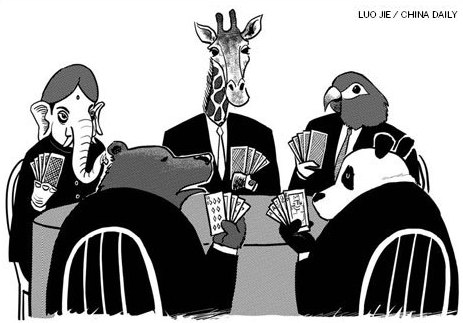
On April 14, President Hu Jintao will meet with Brazilian President Dilma Rousseff, Russian President Dmitry Medvedev, Indian Prime Minister Manmohan Singh and South African President Jacob Zuma. The third formal meeting of BRIC (Brazil, Russia, India, and China) includes South Africa for the first time.
In the past, the advanced economies empowered the world economy. Today, large emerging economies drive global growth. In the emerging world, the future is a source of hope and optimism. In the advanced world, it is often a cause for ambivalence and resignation. In the long run, however, the rise of the large emerging economies is vital to global peace and prosperity.
The concept of the "BRIC" was developed in the early 2000s by Jim O'Neill, then global economist of Goldman Sachs. At the time, these four economies were less than 15 percent of G6 (the United States, Japan, Germany, France, the United Kingdom and Italy) in US dollar terms. Yet projections indicated that by the early 2040s the BRIC economies could be larger than G6. Of course, nothing is inevitable in history. As a group, however, BRIC has emerged from the global credit crisis better than the major economies. As a result, the BRIC economies could become as big as G7 by the early 2030s.
In the early 2000s, Goldman Sachs projected that China's total GDP would catch up with the US' by 2042. After the past decade and the global financial crisis, however, the pace of transition has accelerated. Now it appears that China's GDP may match that of the US by the early 2020s.
The global crisis and the debt burden of the advanced economies will tax their growth for years to come, whereas the BRIC economies may grow twice as fast. And these large emerging economies are followed by "mini-BRICs", including Indonesia, the Philippines, Egypt, Turkey, Vietnam and Nigeria.
A strong BRIC growth does not require "economic miracles". But it does presume macroeconomic stability, relatively high investment rates and trade openness, increasing technological capabilities, growing emphasis on human capital, and political stability.
Now Africa has a representative in the BRIC alignment. In the future, some North African and Middle Eastern countries, too, may join the BRIC league. In the postwar era, Egypt, led by Gamal Abdel Nasser, emerged as the leader of the Arab world. But the gains of globalization have largely bypassed Egypt and its 80 million people despite the great economic potential. In 1980, Egyptians on average were almost 65 percent more prosperous than Chinese. Last year, the Chinese were 15 percent more prosperous than the Egyptians, at purchasing power parity.
One of the most remarkable aspects of the rise of the BRIC economies is the severed tie between total GDP and per capita GDP, that is, the economic power of nations and the average prosperity of their citizens. In the past, the two used to go hand in hand. In the future, that will no longer be the case.
In the 19th century, Britain was the growth engine of the world, and Britons had a relatively high per capita GDP. In the postwar era, the US was the strongest nation, while Americans were the most prosperous people on average. As global growth will be driven by the BRIC economies, the most powerful countries will no longer be the most prosperous.
As long as growth can be sustained in the advanced and emerging economies, all nations can benefit. That is the win-win story. But for that, we need a globalization that is more inclusive in kind.
Economically, the epicenter of the global crisis was the financial sector in the West. In the future, it should pay for excessive risk taking. In the absence of appropriate financial sector reforms, the great global recession would only be a prelude to the next one. Strategically, the postwar multilateral institutions - as forums of global cooperation - must reflect on the proportionate role of the BRIC economies, especially in the United Nations, the World Bank and the International Monetary Fund (IMF).
Since 2005, the advanced economies have urged China to become a "responsible stakeholder" in the international community. But if the multilateral institutions do not reflect the proportionate economic share and political voice of the large emerging economies, they can hardly be considered "responsible".
Under unchanged policies, the IMF says the net debt-to-GDP ratio of G7 would exceed 440 percent by 2050. Does that reflect responsible leadership?
In the West, the rise of the BRIC economies is occasionally said to be a threat to market economy. Yet the reality is the opposite. A decade ago, about 80 percent of Americans saw the free market as the best economic system for the future. After the global financial crisis, this support has plummeted to 59 percent, according to GlobeScan. In China and Brazil, the corresponding support is 67 percent. In India, it's about the same as in the US.
In the coming years, the economic rise of BRICS (BRIC + South Africa) will gradually translate into increasing political power, which will not minimize the value of other multilateral forums. It will only highlight the importance of new forums.
Until recently, the world was led by the multilateralism of the few in the West. In the future, it will be led by more inclusive multilateralism of the many - in the West and the East both.
The author is research director of International Business at the India, China and America Institute, an independent think tank in the US, and visiting fellow at Shanghai Institutes for International Studies.
(China Daily 04/13/2011 page9)

Copyright 1995 - . All rights reserved. The content (including but not limited to text, photo, multimedia information, etc) published in this site belongs to China Daily Information Co (CDIC). Without written authorization from CDIC, such content shall not be republished or used in any form. Note: Browsers with 1024*768 or higher resolution are suggested for this site.
License for publishing multimedia online 0108263 Registration Number: 20100000002731