|
|

US President Barack Obama Visits China 2009
> Obama in China
|
There's room for both of us: ObamaBy Hu Yinan in Shanghai and Wu Jiao in Beijing (China Daily)
Updated: 2009-11-17 06:53
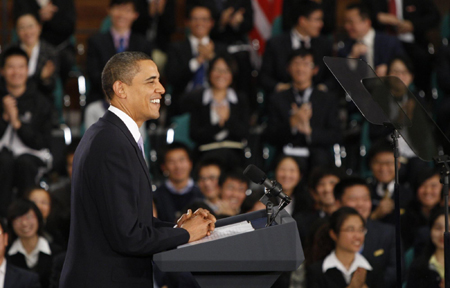
Barack Obama was in typical eloquent form Monday for a signature "town hall meeting" with a difference. While the relaxed style and well-constructed answers were characteristic of the United States president, the fact that he was speaking to around 500 elite Chinese students, possibly the leaders of tomorrow, made the 75-minute session in Shanghai an impressive occasion.
The meeting was heralded as one of the most important events on Obama's weeklong trip to Asia. The president fielded eight questions - half from audience members and half from among those submitted over the Internet - during the casual and free-spirited event. Students smiled and applauded politely when Obama answered questions and chuckled appreciatively when he tried speaking Chinese. "We do not seek to contain China's rise," Obama said during his opening remarks. He assured his young audience the US and China were not "predestined adversaries". One country's success need not come at the expense of another, he said. "On the contrary, we welcome China as a strong and prosperous and successful member of the community of nations, a China that draws on the rights, strengths and creativity of individual Chinese like you," Obama said. The president told his audience difficult problems will not be solved unless the world's only superpower and its rising competitor learn to work together.
Citing the Chinese saying "consider the past and you shall know the future", Obama said the US and China have had setbacks and challenges during the past 30 years that they should learn from.
And when asked about the potentially thorny issue of Taiwan, Obama said the US will continue its support of the one-China policy. He said Washington had been very pleased to see improved cross-Straits relations. "I have been clear in the past, the US supports a one-China policy," Obama said. "We do not want to change that policy or approach." Obama's town hall meeting was not broadcast live across China on television but it was shown on TV in Shanghai and streamed live online via two major Internet portals. Obama used the forum to talk about some of the issues that have been hot topics in the past, including "Internet freedom". "I'm a big supporter of not restricting Internet use," Obama said. "The more open we are, the more we can communicate, and it also draws the world together." He said such values were at the core of US thinking. Tao Wenzhao, an expert on US studies at the Chinese Academy of Social Sciences, said Obama chose a traditional town hall meeting to talk to Chinese youths because such events suit his style as a natural performer and talented orator. Obama's skill as a public speaker helped him win the hearts of young voters and ethnic minorities in the US and he hoped to win over Chinese people in the same way, Tao said. Sun Jingxuan, 19, a second-year undergraduate student at Shanghai Jiaotong University's School of International and Public Affairs, was among the students who asked Obama a question face-to-face. Sun asked Obama if winning the Nobel Peace Prize had increased pressure on the president and she wondered whether the award would change his attitude toward global issues. "I asked him this question because peace is a concern for China and the whole world," Sun told China Daily. "I hope Obama will be worthy of the prize." Obama's answers to the eight questions touched upon a wide range of social issues including history, culture and American values. Tao said the president seemed to have moved on from some of the sticking points that bogged down discussions between the countries in the 1990s, such as human rights. He noted that the US president had labored the point that differences should not block improved cooperation between the countries. After his visit to Shanghai, Obama left for Beijing. He arrived in the capital Monday afternoon where he was greeted by Vice-President Xi Jinping at the airport. Zhang Haizhou, Ai Yang and agencies contributed to the story
|
||||||||||||||||||||
       |
主站蜘蛛池模板: 卢湾区| 广南县| 霍城县| 屏东县| 环江| 台南县| 诸城市| 宁津县| 青阳县| 尤溪县| 兴安县| 南平市| 庄浪县| 开封市| 乌鲁木齐县| 岫岩| 福鼎市| 灵川县| 威远县| 平远县| 开封市| 兰西县| 进贤县| 平和县| 上思县| 绥棱县| 荃湾区| 上饶市| 健康| 黄浦区| 龙州县| 龙胜| 固阳县| 莱芜市| 栾川县| 信宜市| 梧州市| 宁陕县| 页游| 黑水县| 乐都县| 延庆县| 六盘水市| 甘孜县| 乐平市| 绥德县| 公主岭市| 纳雍县| 平阳县| 铅山县| 会东县| 永胜县| 日土县| 江口县| 南部县| 苍梧县| 敦煌市| 平舆县| 调兵山市| 临颍县| 乌拉特前旗| 泌阳县| 双鸭山市| 重庆市| 中方县| 库尔勒市| 银川市| 葵青区| 永丰县| 安远县| 信宜市| 南开区| 民乐县| 南雄市| 开鲁县| 黄冈市| 都兰县| 泸州市| 嘉鱼县| 巍山| 永仁县| 雷山县|