More than 100 music scholars from all over the world came to a conference to discuss the conservation of Asia Pacific music. Mu Qian tunes in.
China is playing a more important role in the safeguarding of traditional music in the world, according to Wang Yaohua, president of the Asia Pacific Society for Ethnomusicology and vice-president of the Music Council for Asia-Oceania.
Wang, who is also a professor with the Music Institute of Fujian Normal University, was speaking at the first academic seminar of Music Council for Asia-Oceania, and the 17th international conference of the Asia Pacific Society for Ethnomusicology, which were held together recently in Jinan, capital of Shandong province.
"By safeguarding its own traditional music, China is making an important contribution to the safeguarding of the world's music," Wang says.
Wang cites the Collection of Chinese Folk Music as an example of China's achievement in the field. The series of books, divided by subjects into folk songs, traditional operas, instrumental music and narrative music, contains 200 million Chinese characters of information. Wang, an editor of the series, has a complete collection of the books which occupies a whole room in his home.
Wang says that since the reform and opening-up, Chinese ethnomusicologists have also learned much from international colleagues, and greatly broadened their view.
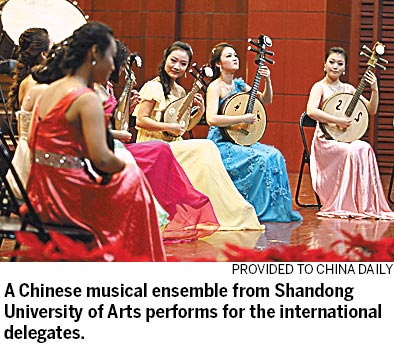
The Asia Pacific Society for Ethnomusicology was founded in 1994 with the objective of preserving and safeguarding the ancient and traditional music of the region. Since then, China has held 10 of the organization's 17 international conferences. More than 100 scholars from different countries attended this year's conference, which was presented by Shandong University of Arts.
With increasing international exchanges, Wang has found that Asian music, especially Chinese music, is often incompatible with Western theories that are accepted internationally.
"Interpreting Chinese music with Western theories often causes misunderstanding. For example, we often talk about Peking Opera, but it is a genre that has very different content and aesthetics compared to Western opera. Thus, calling it 'opera' is a wrong simplification," he says. "We need to come up with our own terms instead of copying from the West."
Wang, who is a co-founder of the Asia Pacific Society for Ethnomusicology, says the organization aims to contribute ethnomusicological theories suitable for the music cultures of the region.
Kwon Oh-sung, professor emeritus with the Hanyang University of Korea, echoes Wang's remarks.
Kwon contends that Koreans, Chinese and Japanese share a tradition in which poetry, calligraphy and painting are combined with instrumental music and singing, and further discussion on this tradition of East Asian musicology is necessary in the future.
Compared to the Asia Pacific Society for Ethnomusicology, the Music Council for Asia-Oceania is an international organization that covers not only traditional music, but all kinds. A regional council of the International Music Council, it aims to create better understanding among diverse cultures through music in the Asia-Oceania region.
The organization's president Helen Lancaster says that with the integration of Asia and Oceania, music exchanges between countries in the region have become more common and fruitful.
Lancaster, who is executive manager of the Queensland Conservatorium of Australia, has witnessed a project of collaboration between musicians from China's Sichuan province and her school.
The Wide Alley project began in 1999 when Zou Xiangping, a professor of composition at Sichuan Conservatory of Music, invited percussionist Vanessa Tomlinson and composer Erik Griswold to visit Chengdu, capital of Sichuan.
These three musicians bring a variety of skills to the collaboration, including local narrative music qingyin, jazz and free improvisation. They were joined by others who also brought intercultural experience to the mix, including Chinese vocalist Tian Linping, bamboo flutist Shi Lei, and trumpet player Peter Knight.
"Here lies a good example of the potential of music exchange in the Asia and Oceania region, that we might learn more about each others' traditions and create beautiful new collaborations together - musically, and culturally," Lancaster says.
Contact the writer at muqian@chinadaily.com.cn.

|
|
|
|
|
|
|
|

Copyright 1995 - . All rights reserved. The content (including but not limited to text, photo, multimedia information, etc) published in this site belongs to China Daily Information Co (CDIC). Without written authorization from CDIC, such content shall not be republished or used in any form. Note: Browsers with 1024*768 or higher resolution are suggested for this site.
License for publishing multimedia online 0108263 Registration Number: 130349 





















 Raymond Zhou:
 Pauline D Loh:
 Hot Pot
 Eco China
 China Dream
 China Face