 |
|
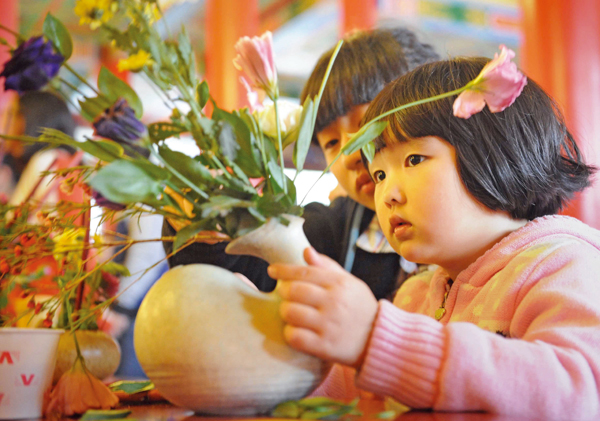
Children enjoy the art of flower arrangement. |
"This is one of the motives that drove me to do research and teach such courses in the first place," Wang says. "Chinese flower arrangement, although not being mainstream at present, is not at all inferior to the other two styles."
One of her most popular weekly courses is "Chinese flower arrangement and Japanese hanamichi", held in a corner of the verdant campus, where she lectures on the relationship of the two forms and their evolution.
Chinese flower arrangement first appeared during the early Southern and Northern Dynasties (AD 420-581). However, Wang believes it started much earlier.
The Book of Songs written more than 3,000 years ago features many scenes of young lovers cutting flowers, twigs and leafs as tokens of courtship.
In the Late Eastern Han Dynasty (AD 25-220), with the introduction of Buddhism from India, practitioners started to place cut flowers at temple altars, and for a long time, flower arrangement took on a strong religious flavor with strict rules.
Part of the reason was that Buddhism forbids the killing of animals, and so cuttings from plants were used as offerings. Also, dedicating time to arranging flowers and leaves symbolically and aesthetically reflects continuous piety toward the Buddha.
During the Southern and Northern dynasties (AD 420-581), rules were relaxed and an influx of variations followed, including flower arrangement in hair styles and costume decoration, such as brooches. From this period, flower arrangement blossomed into a much more artistic pursuit.
In the Tang Dynasty (AD 618-907), flower arrangement became popular among aristocrats and the imperial court. It was also during this period that the art spread to Japan.
Come the Song Dynasty (960-1279), the art gained wider popularity, especially among the literati, and artistic conception became more varied as new cutting techniques were introduced.
Flower arrangement, along with tea making, mounting of paintings and incense burning, was regarded as a standard pursuit for gentlemen who sought inner tranquility.
Plum blossom, orchid, bamboo and chrysanthemum are deemed the four gentlemen of flowers, because the plants' natural characteristics represent loftiness, righteousness, modesty and purity.
During the Ming Dynasty (1368-1644), more weight was placed on naturalism, with less emphasis on the balance of beauty, structure and meaning. It promoted asymmetrical beauty, which also had a great influence on Chinese garden design and landscaping.
Naturalism is Wang's ideal of perfect flower arrangement. Symmetry, with straight columns and lines, would look rigid and unnatural. Wang is strongly against tying flowers up with knots to this end.
But "naturalism does not mean arranging the flowers chaotically or prosaically", she says. "There are still limits. One should always follow the botanical principles to keep the appearance natural."
Contact the writer at zhanglei@chinadaily.com.cn.
|
|
|
| The eyes have it | Seeking deliberation in a scarf |
|
|
|
|
|
|
|
|


Copyright 1995 - . All rights reserved. The content (including but not limited to text, photo, multimedia information, etc) published in this site belongs to China Daily Information Co (CDIC). Without written authorization from CDIC, such content shall not be republished or used in any form. Note: Browsers with 1024*768 or higher resolution are suggested for this site.
License for publishing multimedia online 0108263 Registration Number: 20100000002731 
















 Raymond Zhou:
 Pauline D Loh: My Chinese Kitchen
 Ye Jun:
 China Face
 Hot Pot
 Eco China