A right royal restaurant
Restaurant review
| Ye JunEmpresses and royalty used to dine in the Summer Palace, an extravagant park built for the sole amusement of the last rulers of the Qing Dynasty (1644-1911). No wonder then that the opulent beauty and grandeur of the restaurant still awes the modern diner.
Ting Li Guan, an imperial-style restaurant inside the Summer Palace, has an equally poetic name, which translates to "a place to listen to the yellow oriole". Birdsong is compared to the beautiful melodies in opera and music, and it is this name that the dowager empress Ci Xi (1835-1908) gave to this restaurant where she entertained foreign diplomats, court officials and the emperor's wives.
It is in a scenic location, just in front of Wanshou Mountain, and facing Kunming Lake.
Ting Li Guan was built by Emperor Qianlong (1711-99) to celebrate the birthday of his mother. In 1860, the allied forces burned it down, but the dowager empress Ci Xi rebuilt it.
She was so powerful that it was said her kitchen was even bigger than that of the emperor's.
Tourists to the Summer Palace will remember the long corridor in front of Wanshou Mountain, with beautiful paintings on the roofs and girders. The same paintings can be found inside Ting Li Guan, in an even more elaborate setting.
There are many indications that this was once the dowager's favorite spot. The entrance is decorated by a huge Chinese character representing "longevity", written by Ci Xi herself. And inside the restaurant is a stage with a roof, where the empress indulged in another favorite pastime - watching Chinese opera.
It is hard not to be impressed by the grandeur of the decor. There are vivid, colorful paintings of flowers and birds on the roof, besides beautiful chandeliers and Chinese lanterns.
There are articles praising the merits of the imperial family and the beautiful art on the girders. These are now copies, of course, and the originals are all in the Palace Museum.
The food is equally impressive, and the menu sets the mood with impressive poetry. The appetizer, danfeng chaoyang, or "phoenix flying toward the sun", is almost as beautiful as the paintings.
Pork slices, with red skin and pink meat, are arranged neatly as the wings. The tails are paved with slices of green cucumber, and yellow strips of omelet, quail egg halves and cherries.
It is a work of art on a plate, and the diners around the table are almost reluctant to eat it for fear of destroying the intricate picture.
An individually served helping of the cold appetizer has seven ingredients: mushroom, shrimp, seaweed, bean curd, pork slices, carrot and peas, each in bite-sized servings.
There were also several plates of traditional Beijing snacks, such as yellow pea cakes, white kidney bean rolls with white sugar, and wowotou - little cone-shaped steamed buns made of corn and chestnut flour.
Main dishes are flavorful braised sea cucumber with pork tendons, steamed codfish with salty soybean sauce, and a soup of fresh abalone and white asparagus.
The waitresses wear Qing Dynasty palace robes and a broad headdress with a big red flower, and walk around in the traditional Manchurian clogs.
In between serving, they narrate stories about the dishes, such as a round cake with minced pork filling, which was named "dreams come true cake", and a shrimp and venison dish created by a palace maid who wanted to marry outside the imperial palace.
An "eight treasure" fish soup is cooked by the table, with fish slices, shrimp, chicken, starch noodles and green vegetables. The waitress prepares it on the spot in a big bronze pot heated with charcoal.
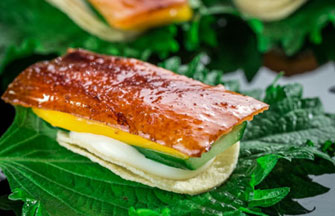
Ting Li Guan also serves a closed-oven roasted duck with perilla leaves.
Imperial-style cuisine has been granted intangible cultural heritage status by the Beijing government for its intricate presentation and delicate tastes.
The restaurant has seven private rooms with a seating capacity of 400 people. Set meals are served starting from 136 yuan ($21), plus a 10-percent surcharge per person. At that price, there are four dishes and a soup.
Private rooms cost from 5,000 yuan for a table of fewer than 10 people. The restaurant receives individual guests or small groups, but reservations for dinner is a must. Peking Opera performances can be organized in the afternoon and evening.
Contact the writer at yejun@chinadaily.com.cn.